
Simon Bourgeois on Vintage: ‘I've Been Hunting for 10 Years. That's When Everything Clicked’
Ten years ago, a guy from Besançon wondered why real jeans didn't exist in France. Today, Simon Bourgeois drives across America in a 4x4, meets ranchers in Nevada, negotiates with collectors in California, and collects vintage denim like a kid picking up shells on a beach..
September 25-27, he arrives in Paris with his hunt.
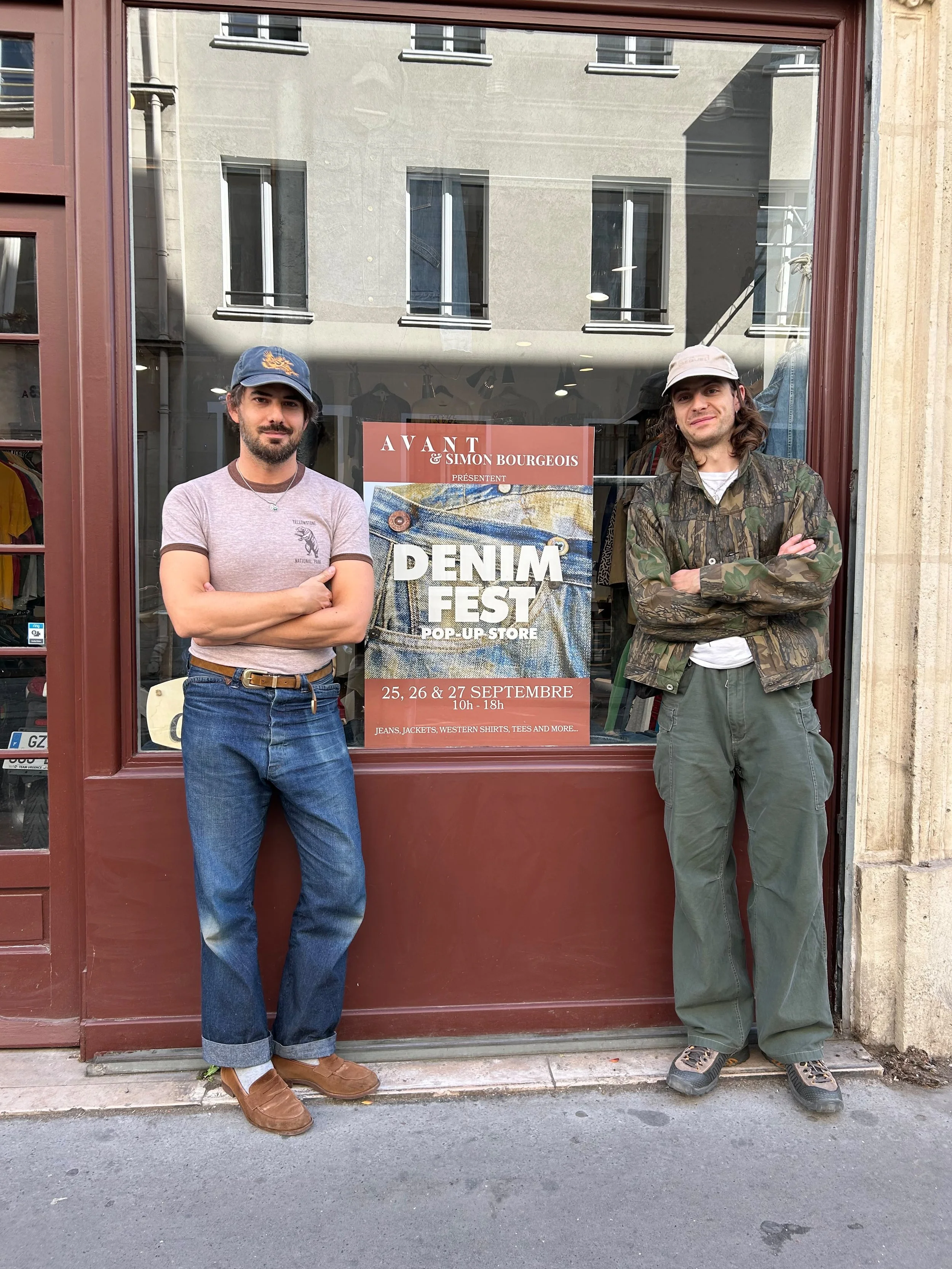
Simon Bourgeois & Eric Maggiori in front of AVANT Showroom in Paris.
Who are you in one sentence?
A guy obsessed with denim for 10 years who crosses America to find the most beautiful vintage pieces.
400 pieces of denim – how did you end up with that?
Honestly, I didn't count them while buying (laughs). It happened little by little. I must have said yes to about ten opportunities over six months. One day someone tells me "I have 200 Levi's 90s in my garage," another day it's 80 Wranglers from a rancher in Nevada. Then you look at the pile and it's 400.
But what really matters is that I touched every single piece in person before buying it. I check the stitching, the density of the denim, the tags. It's a language. If you learn it, you know right away if it's real and if it's worth it.
The "language" of denim – what exactly is that?
It's understanding why a seam is thick. Why the pockets are deep. Because the original Levi's 501 was a work pant. Workers put tools in those pockets. And 40 years later, a 25-year-old kid in Paris buys it because it looks cool. But what makes it really cool is that it did exactly what it was designed to do. It's not fake. It's not fake cool.
Where are you from? How did you become obsessed with denim?
I'm from Besançon, eastern France. At 11, I discovered skateboarding, and that's when everything clicked. Wassup Rockers, the Larry Clark film – you know it? Young guys from LA on skateboards, tight jeans, punk in their ears. Not vintage to look like a fashion victim, just to live. That was it. That was real.
From there, I understood that clothes speak. So I started hunting. At Emmaüs thrift stores, on eBay, at flea markets. At 21, I moved to Paris, working at a vintage shop. At 30, I opened a small shop in Boulder, Colorado. Now I cross America with my wife.
Boulder – that was your Chalet shop, right? Why did you close it?
Yeah, we had a great spot in an old house from the 1890s overlooking the Flatirons. We sold incredible vintage outdoor gear: parkas, down jackets, denim obviously. Designers from Patagonia and Arc'teryx would come to us for reference pieces.
What I loved about Chalet was showing people that you could love clothes without being obsessed with brands. That you could have a real story with what you wear. Students would walk in randomly and discover vintage for the first time.
We closed because old house equals endless problems. But we're not closing the door to another opportunity if everything aligns.
How do you hunt for denim in the United States?
First, "warehouse sales" – private sales where collectors empty their stock. I'm always among the first to arrive. There are also road trips: California for Levi's people forgot to sell, Midwest for workwear that becomes vintage by accident, Texas for Wranglers hidden in attics.
But the real magic is relationships. You meet someone, show them you know how to look, that you understand what you're holding. Then one day they tell you "I have something for you." That's where the real hunt begins.
Why does denim change from region to region?
Because each region has its own story. California is Levi's and the California dream. LA is 90s Levi's 501s worn by skaters. Colorado is rustic denim, part workwear, part ski wear. Texas is authentic Wrangler, denim that was actually worked in.
I spent six months a year there for three years. You start to understand: the guy from Wyoming doesn't buy the same jeans as the skater from San Diego. And that's a gift because it means there are different stories everywhere.
Let's talk about patina. What is it really?
It's a textile diary. A Levi's 501 from the 1950s worn by someone for 20 years – that's not just pants. It's that person's story. The holes where they sat, the stains, the fading – it all tells something.
The incredible thing about denim is that patina, holes, fading – it becomes more beautiful with time. The garment ages with you. It doesn't try to be anything else. It's honest.
What role did Wrangler play in your collection?
Yeah, I'm obsessed with Wrangler. Not just because it's cool. Wrangler was really the jean of cowboys, ranchers, workers. There's a raw Americana side to it that fascinates me.
The Wranglers I've found are usually genuinely worn. Not fashion week jeans. Jeans that actually worked. There's an authenticity there you don't find everywhere.
You say you hunt. Is it an addiction?
It's my job, but it's also my hobby. Kind of unbalanced, right? But it's the only way to stay honest.
Honestly? It's the hunt that gets me. It's the moment you open a batch of clothes and one piece hits you. You touch it. You look at the weave, the color, the stitching. And you know. You know it's something.
But it's also meeting people. When a 20-year-old discovered vintage for the first time at Chalet, that changed something for me too. It reminded me why I love this.
How do you select the 400 pieces for the pop-up?
Every piece has to have a reason to be there. I could tell you which region I found it in. I could show you why it's good. I could advise you if you're looking for specific patina or a forgotten cut.
At the showroom there will be everything: 90s for people who love the grunge era, 80s for color lovers, 70s for those who want pure denim essence. And then there's me to talk, to share, to show why these pieces deserve attention.
What do you want people to understand about vintage denim?
That it's not just a trend. That it's a real story. That a Levi's 501 made in USA is an intelligent product designed to last. That there's a difference between "fashion victim" vintage and vintage that actually lived.
And especially that denim is a garment that's always been a bridge between worlds. 19th-century American workers. 1970s punk skaters. Hippies fighting the system. Denim has this incredible capacity to be honest with whoever wears it.
What do you mean by "honest"?
You wear it, you beat it up, it ages with you. It doesn't try to hide. It becomes more beautiful with age. It's the opposite of most clothes today that fall apart after two months. Denim is something that crosses time. That's why I look at it.
If someone knows nothing about vintage denim, where do they start?
Come to the pop-up (laughs). No seriously, the best way is to touch it. Try it on. Understand the difference between 90s raw Levi's and 1970s Wrangler. Feel the fabric density. Listen to someone who knows how to talk about it.
That's why I believe in retail, even in 2026. In-person expertise matters. Being able to touch the product – that changes everything.
Your three iconic pieces from the pop-up?
There's a 1980s Levi's 501 made in USA with perfect gray patina. A 1970s Wrangler so worn the denim turned pale. And then I want to show a forgotten brand – a 90s jean from a brand nobody knows but that had incredible style.
Each tells a different story. That's the point – to show there's no single story to denim. There are thousands.
September 25-27 – why come?
To meet someone who actually searched. To touch 400 carefully selected pieces. To ask questions: why are you obsessed with Wrangler, how do you hunt, what's the difference between two Levi's, all of it.
That's where real conversations start. That's where it becomes more than a transaction. You can show me a piece and ask my opinion. Or tell me what you're looking for and I'll show you. It's personal.
Last message for everyone reading this?
Come curious. Come and touch things. Come with questions. And if you find a piece that speaks to you, take it. Because once it's gone, it's gone. These 400 pieces won't all come back to Paris. This is a moment that only happens once.

AVANT Denim Fest: September 25, 26 & 27th | Paris
46 rue Saint-Sébastien.