
Black Cowboys: A Forgotten History
The Hidden Presence of Black Cowboys in the American West
Black cowboys in the American West accounted for up to an estimated 25% of cowboys “who went up the trail” from the 1860s to 1880s and a substantial but unknown percentage in the rest of the ranching industry, estimated to be at least 5,000 workers. Long erased from history books, Hollywood movies and rodeos, Black cowboys are now slowly finding their place, mainly thanks to culture and fashion, which is finally bringing them to the limelight.
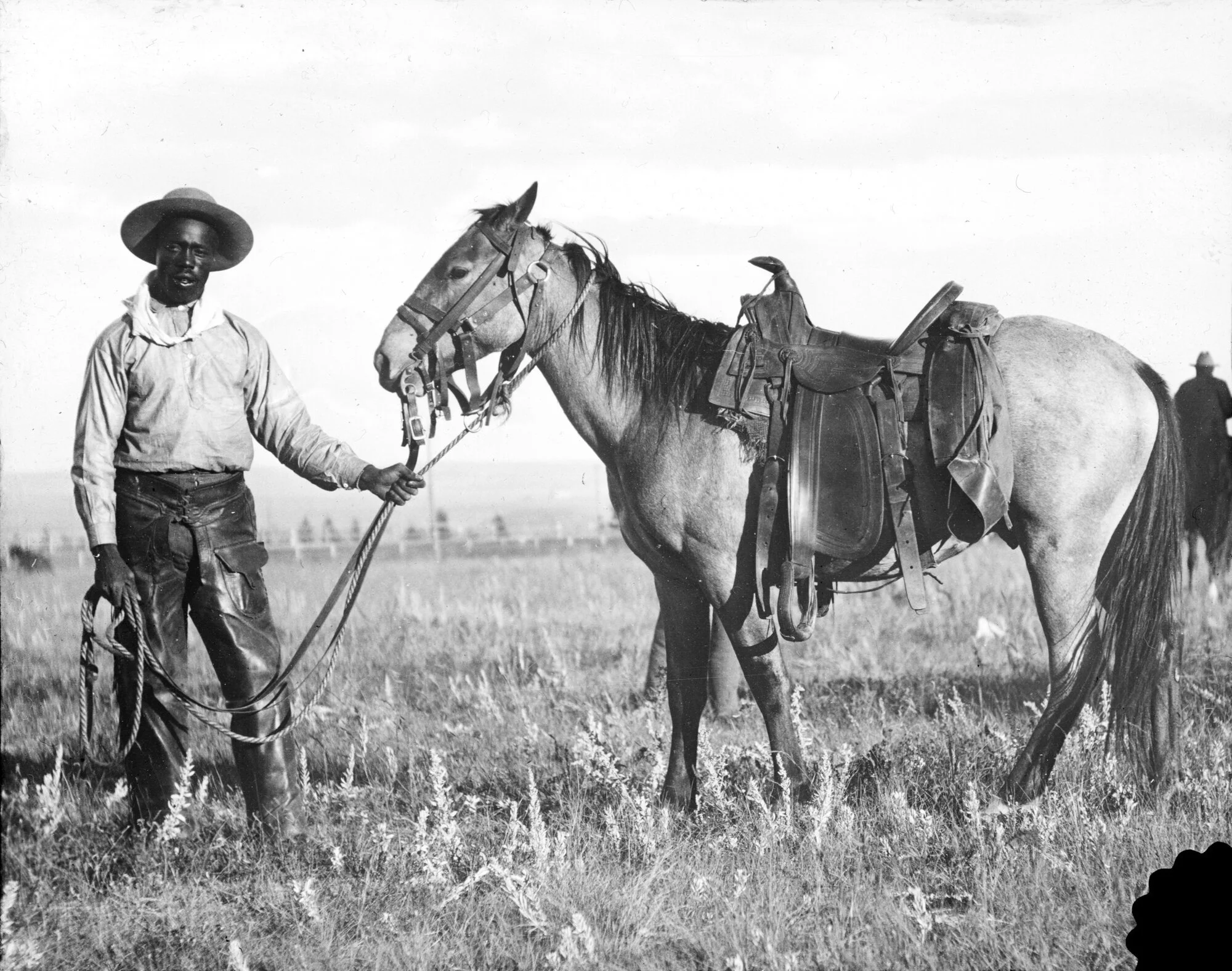
Black Cowboy and HorseDenver Public Library
A Rising Spotlight Through Culture and Fashion
In early November 2022, the Brooklyn Circus concept store unveiled a collection in collaboration with Lee brand. What was the objective of this collaboration? To valorize Black cowboy history, often left out in history books. A small revolution. “We find our inspiration in the pages of history, so collaborating with a brand like Lee to highlight the history of the West and its Black workers was perfectly logical,” said Ouigi Theodore, founder and artistic director of Brooklyn Circus. This initiative is in line with the rehabilitation of African-American cowboys, who, after the Civil War, represented between 25 and 35% of cowboys in the United States. Former slaves or descendants of freedmen, they had been freed at the end of the Civil War and had fled to the West in search of a better life. “The idea of the West, away from the racial oppression of the South, was attractive to these freed slaves. It was a land of adventure, full of opportunity, a few years after the Gold Rush,” explained historian Esther Cyna, a specialist in racism, political history and education in the United States.
Once they arrived in the Western Territories, many of these African-Americans became farmers and cowboys, in particular, because, on the ranches where they had been slaves, they had been taught the art of the lasso and how to ride a horse. But even when they were free, and even in these low-level jobs, racial segregation was never far away. This was evident in the fact that of all the cowboys and riders in Buffalo Bill’s Wild West Shows, none were Black, except for one Jesse Stahl. Actually, Black rodeo riders would be compared to animals, given nicknames reflecting African animals and using animal metaphors not found in descriptions of White rodeo performers.

Nat Love, Public Domain
Nat Love: A Voice From the Saddle
“The cowboy world was no exception to racism, segregation, even if it was more mixed and integrated,” said Esther Cyna. But some Black cowboys still managed to make a name for themselves. Among them was Nat Love. Born in 1854, he grew up in a slave hut in Tennessee, went to Dodge City at the age of 15, worked for a track keeper and became a celebrity in rodeos thanks to his talent with horses. “If there is one Black cowboy we know, it’s him,” asserted Esther Cyna. He was the first to tell his story.
Beyond his autobiography, Nat Love was also the lead character in The Cherokee Kid, released in 1996, or more recently in The Harder They Fall (2021), a Netflix blockbuster produced by Jay-Z, which also glorifies other Black characters of the Wild West, such as Rufus Buck, the terror of Oklahoma in 1895, trapper Jim Beckwourth or Bass Reeves, the first Black sheriff west of the Mississippi, author of 3,000 arrests. Unfortunately, in its heyday, Hollywood and its industry were not so inclined to feature black cowboys. In fact, it was quite the opposite.
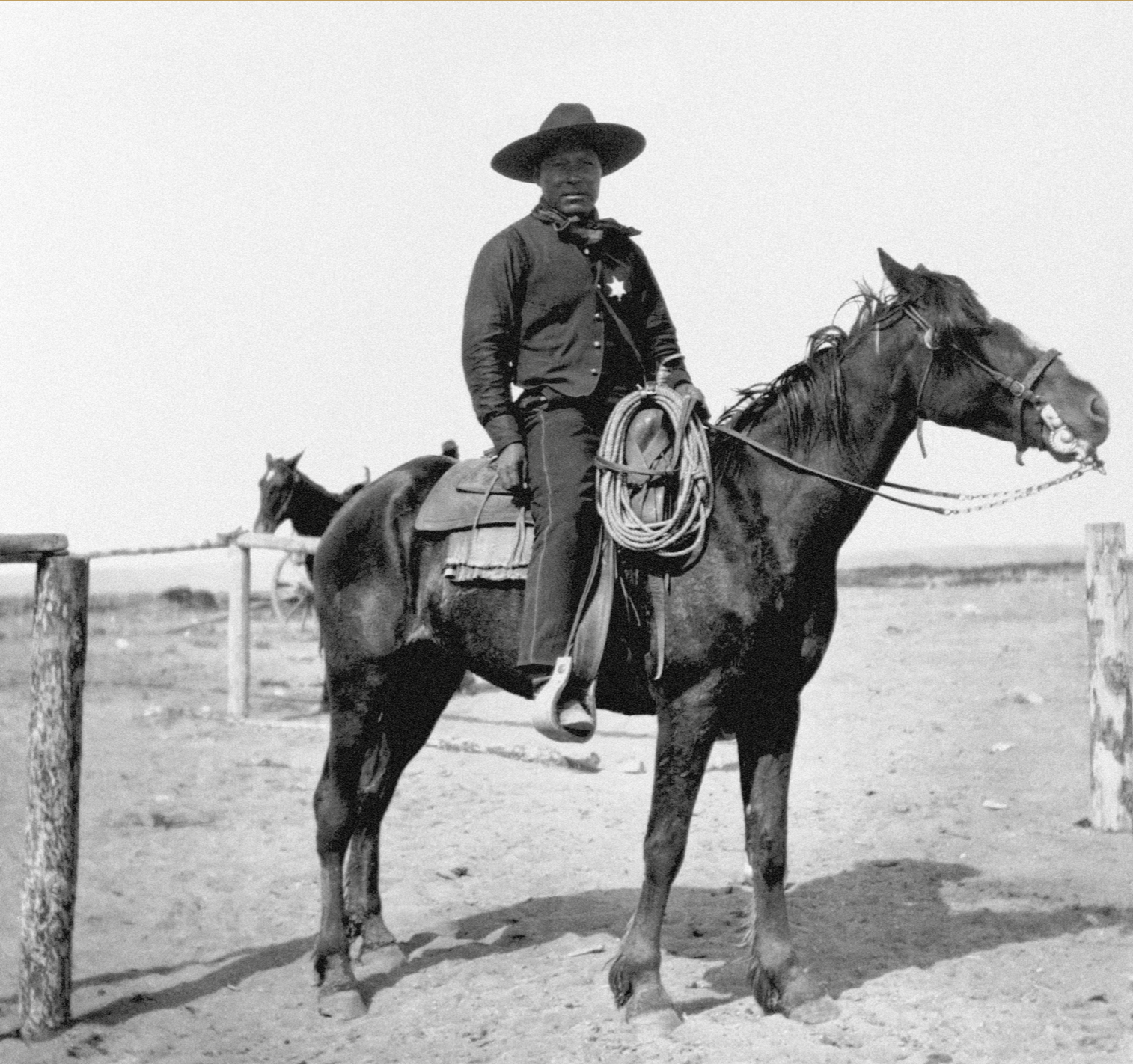
An African-American sheriff, Pocatello, Idaho, 1903, Public domain
Hollywood’s Exclusion and the Whitewashed Myth
“For years, Hollywood had strict, more or less unspoken rules. Blacks were not to be put on a pedestal. Heroes were straight White men. This was a hard-to-challenge rule until the 1970s, recalled Esther Cyna. History portrayed the Black population as victims, people undergoing suffering, while there were heroic, strong, sometimes violent figures. Power and strength were not only for Whites.” The Black American West Museum was the first to attempt to correct history, opening its doors in Denver in 1971, fifteen years before the launch of the first black rodeo: the Bill Pickett Rodeo, which today has more than 2,000 professionals and welcomes 130,000 visitors a year, with Savannah Roberts as its figurehead. African-American cowboy groups from New York to Los Angeles have also been at the forefront of the Black Lives Matter movement, such as the Compton Cowboys.

This page is extracted from An Anthology of Western Wear by AVANT.
The Legacy Continues
“Black heritage is fundamental to the current image of the Black cowboy, said Tyree Boyd-Pates, curator of the Black American West Museum.“It deserves to be recognized, reclaimed and amplified to share the diverse contributions these groups made to shaping the American West.” Little by little, the memory of Black cowboys is thus finding its rightful place. From Netflix to the windows of Lee’s and Brooklyn Circus stores.
.BY ADRIEN HÉMARD-DOHAIN & ERIC MAGGIORI.
This article has been initially published in our issue “An Anthology of Western Wear”.