The Worker's Musette: From French Workwear to Modern Carry
There is a specific category of bag that has survived, almost unchanged in silhouette, for more than a hundred years. It is soft, unstructured, made of canvas, closed with a flap and a buckle, and carried across the body by a single adjustable strap. In French it is called a musette. In English, the nearest equivalent is the haversack, though neither word is perfectly interchangeable. This bag is not, strictly speaking, a fashion object, though fashion has borrowed it many times. It is something closer to an infrastructure of daily life, the canvas carryall that generations of Europeans have reached for when they needed to bring a few things with them into a long day.
The story of The Musette is interesting precisely because it refuses to belong to one lineage. It has been a soldier's bag, a fly angler's bag, and a tool-carrier for tradespeople whose names were never catalogued. It has been reissued, imitated, and romanticized across a century of editorial campaigns. And it has, in the last fifteen years, re-emerged in the hands of a small French house that has made it the centerpiece of a contemporary carry catalogue. This is, piece by sourced piece, how the form travelled from then to now.
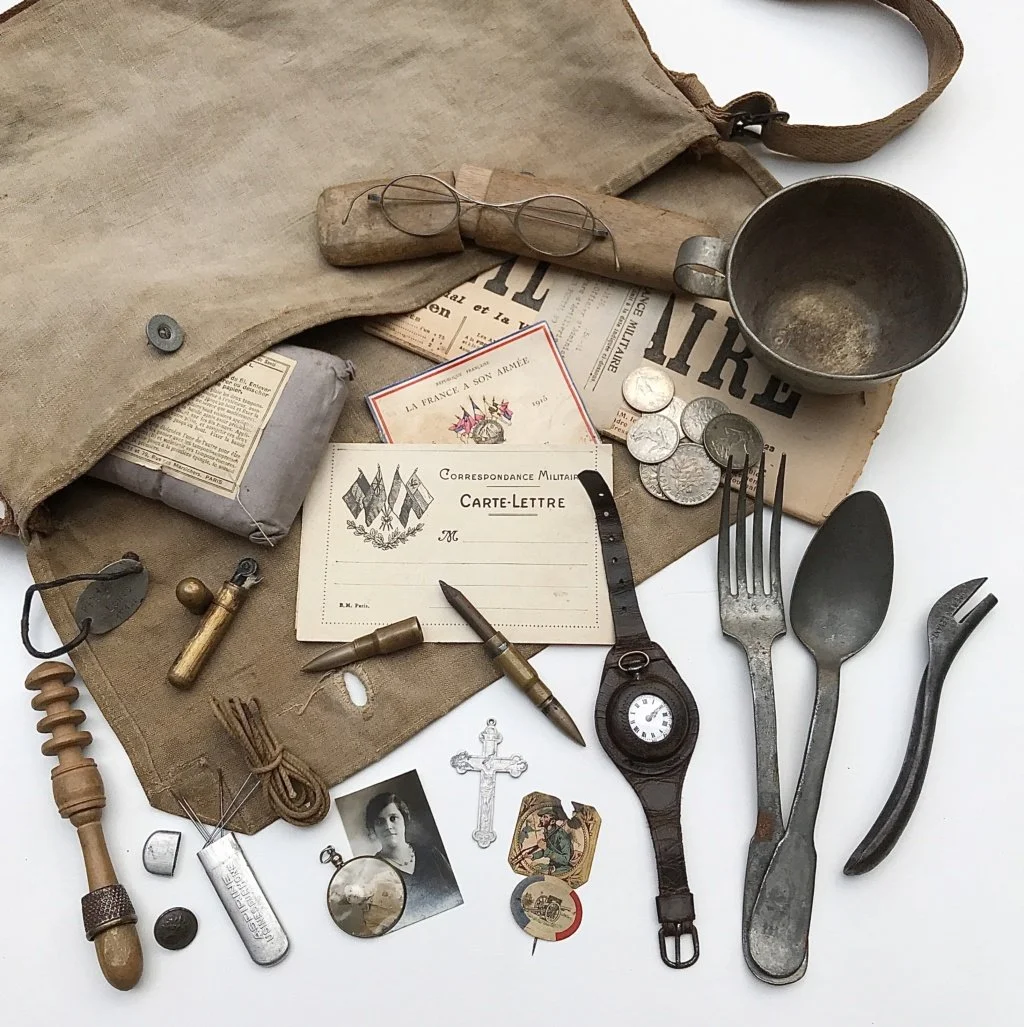
The Word
The word musette in its bag sense is French and military in origin. The Musette de campagne was the small canvas shoulder bag standardized and issued in the French army, which subsequently passed into international currency when American and British forces adopted similar designs. The American M1928 Musette Bag was developed to replace the World War I issue M1910, and was followed in turn by the M1936, a smaller variant issued to paratroopers and officers, which according to reference military-equipment archives was itself a copy of the British officer's musette bag of the First World War (sources: U.S. Army Quartermaster reference archives, Olive-Drab military equipment documentation, WW2 Facts reference wiki).
The etymologically related term haversack has a different root. It comes from the German Hafersack and Dutch haverzak, literally "oat sack," a small cloth bag on a shoulder strap that originally carried horse fodder. The term was adopted by English and French cavalry in the seventeenth century, long before it migrated into civilian vocabulary (source: Wikipedia reference entry on the haversack).
These two words, musette and haversack, describe the same basic form, which is a canvas shoulder bag with a single adjustable strap, closed by a flap, sized to hold a day's belongings and nothing more. They are also the two words that any honest history of this object is obliged to carry side by side.
The Parallel Lineages
The musette did not have a single origin point. It had several, and they are best understood as parallel rather than sequential.
The military lineage is the most fully documented. Through the first half of the twentieth century, successive iterations of the musette (the French musette de campagne, the British World War I officer's musette, the American M1910, M1928, and M1936) established the form as a universal soldier's carry object, made of heavy cotton canvas, often in olive drab or khaki, with brass hardware and simple leather reinforcements (sources: Olive-Drab military equipment archive, U.S. Army Quartermaster Foundation references, WW2 Facts reference wiki). Millions of these bags were produced between 1914 and 1945. A significant portion of them entered civilian life as war surplus.

The fly-fishing lineage is documented separately, though less exhaustively. The French house Bleu de Chauffe, whose brand archive is one of the few places where this history is formally collected, traces what it calls the fisherman's musette to the rise of fly fishing at the beginning of the twentieth century. The argument is functional: fly fishing demanded a mobile angler, moving continuously along rivers and streams, and the rigid wicker creel that had served earlier generations of anglers was a poor fit for that style of fishing. A soft, waxed canvas shoulder bag, worn crossbody, that kept its contents dry and left the hands free, was a more logical tool, and the musette form answered the brief.
A third strand of use, harder to trace but visible in vintage marketplaces and in the positioning of contemporary heritage houses, is the civilian carry of soft canvas shoulder bags by tradespeople, couriers, and other working adults across twentieth-century Europe. These bags rarely carried brand names, circulated through regional workshops and army-surplus channels, and were absorbed into daily life without formal cataloguing. Bleu de Chauffe, whose founding mission is stated on the brand's history page as an effort "to reinterpret French work bags of the 20th century, creating them for the modern world while staying loyal to what made them unique", is one of the few contemporary houses to claim this lineage explicitly.
These three strands (military, angling, civilian) are not mutually exclusive. They share the same canvas, the same hardware, and the same silhouette. What they do not share is editorial attention, which is why most contemporary writing about The Musette reduces it to one of the three, usually the one best suited to the aesthetic being sold at the time.
How the Form Survived
The Musette's continued existence into the twenty-first century is, in retrospect, a minor miracle of material continuity. Most bag categories do not survive a century. Briefcases have been reengineered every decade. Backpacks have been redesigned for every new load type. The Musette, by contrast, has required almost no structural revision. Its original logic, which is that a soft bag is better than a rigid one for anyone who needs to move with it, remains valid in 2026.
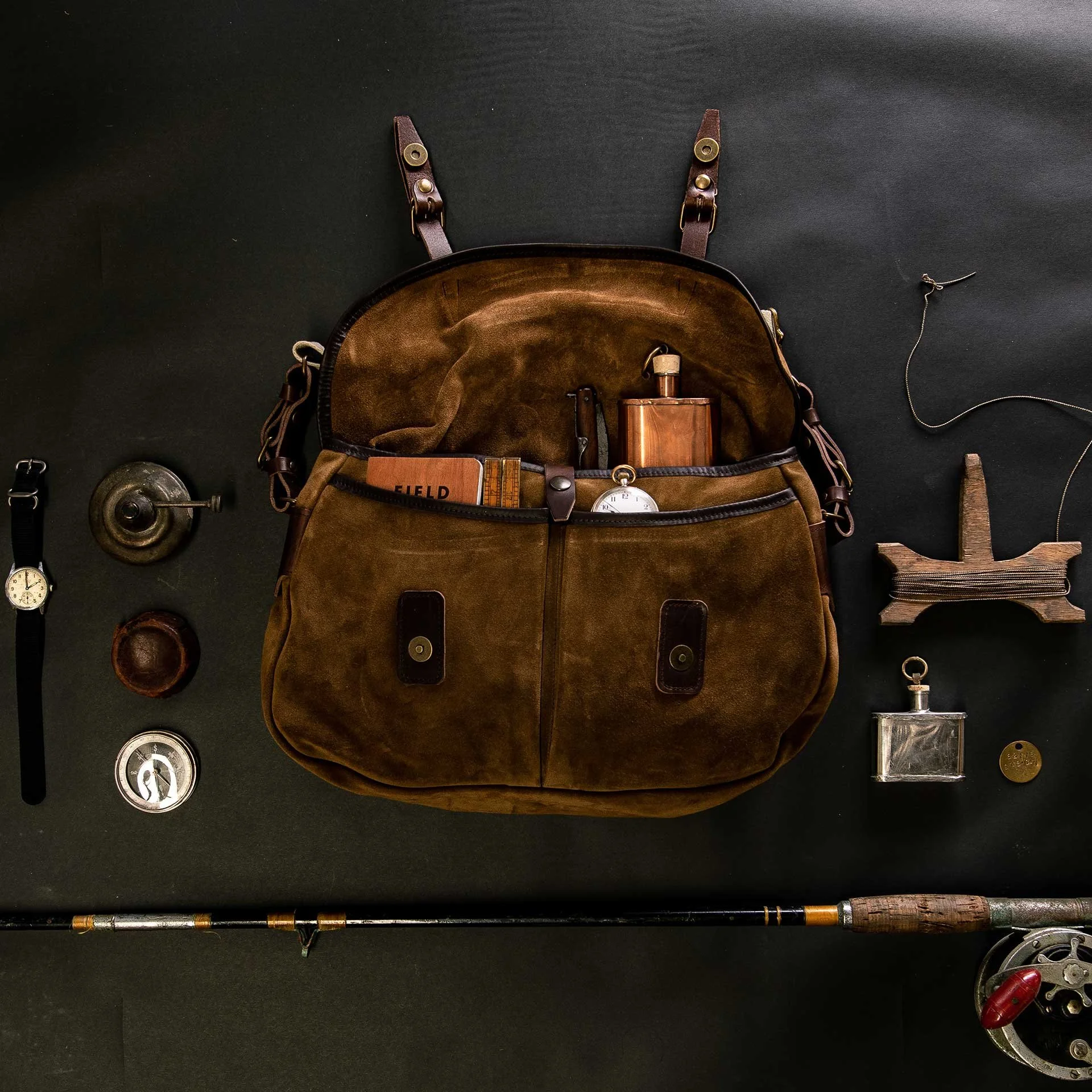
What has changed is the carry itself. A canvas shoulder bag built to hold a cup, a notebook, and a tobacco pouch is not automatically equipped to hold a fifteen-inch laptop and a charger. The contemporary makers who have chosen to rebuild the musette (a group that includes Bleu de Chauffe, Mismo, Porter Yoshida, Margaret Howell, Property Of..., and Filson, among others) have had to reconcile two imperatives. The exterior must remain faithful to the historical form, because that form is the source of the bag's credibility. The interior must be engineered for modern carry, because a heritage object that cannot hold a laptop is, in 2026, a decorative object rather than a useful one. This is the design problem that the current generation of musette makers has been quietly solving for fifteen years.
Bleu de Chauffe: The Atelier Argument
Among the houses active in this space, Bleu de Chauffe has become, for a certain kind of careful buyer, the reference. The brand was founded in 2009 by Thierry Batteux and Alexandre Rousseau, the latter an alumnus of the Richemont group, where he worked on watches and leather goods for Cartier, IWC, and Jaeger-LeCoultre. The atelier is located in Saint-Georges-de-Luzençon in the Aveyron region of southern France, near the Millau Viaduct.
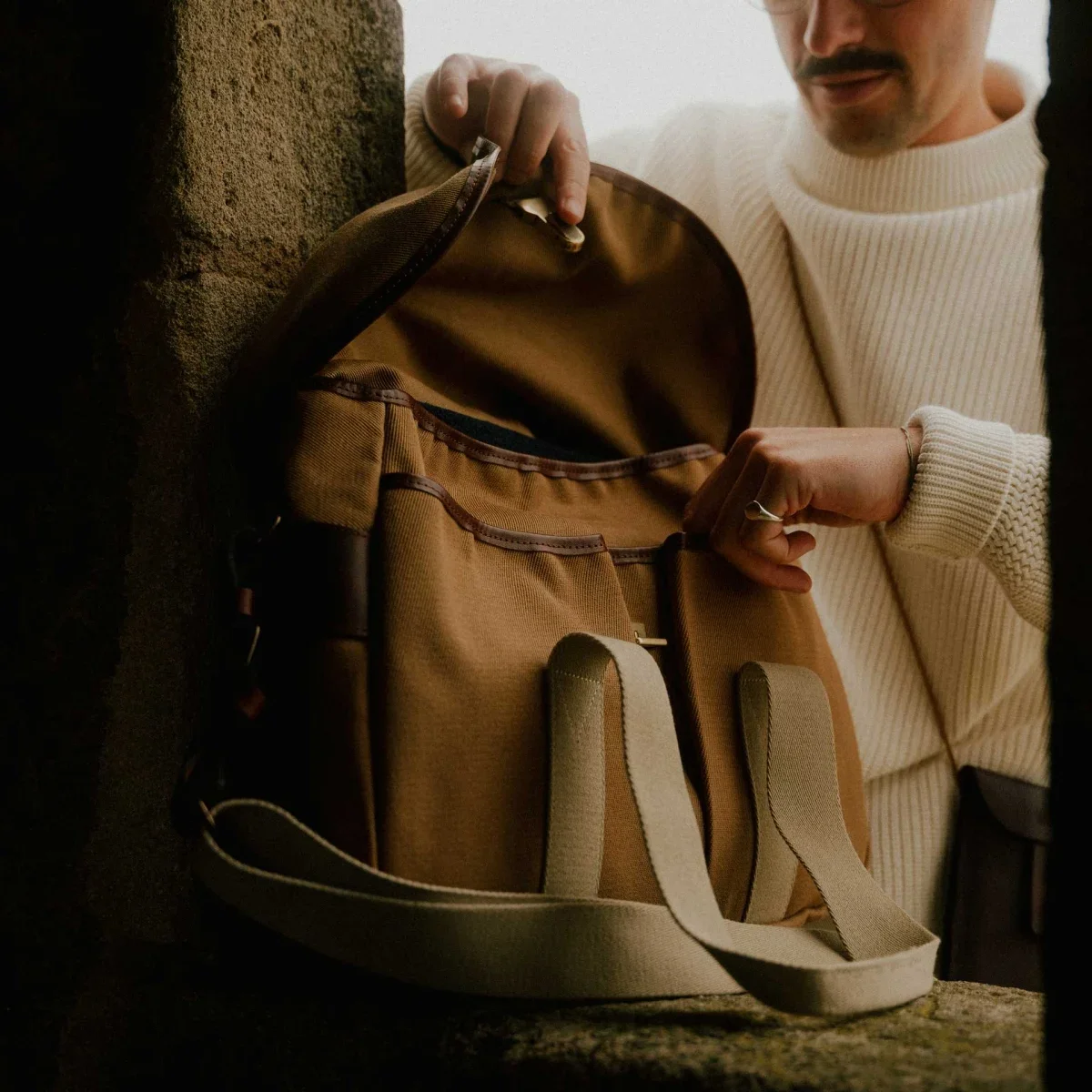
The manufacturing philosophy is consistent across coverage: every Bleu de Chauffe bag is made from start to finish by a single artisan at the Aveyron workshop, who signs the interior with an embroidered tag bearing their first name (sources: Stridewise, Bonnegueule, Bleu de Chauffe official). Leather is sourced from French and Italian tanneries, cotton canvas from British Millerain, wool felt from France, and hardware from France, Italy, and Belgium. The house does not scale production in the way that volume brands do, which is a deliberate constraint rather than a marketing narrative.
The Musette Business BM
The most complete synthesis of the musette tradition in the contemporary Bleu de Chauffe catalogue is the Musette Business BM. The exterior canvas is 18-ounce lick-waxed serge from British Millerain at 590 grams per square metre, a tight weave specifically engineered to resist wear and stretching. The bag holds 16 litres, a volume that falls between a day bag and a small briefcase, with two front pockets that close under a center flap so the hand can be slipped in without fully unfastening the bag. The leather trim is full-grain bridle, the interior carries a padded laptop sleeve, and the hardware is solid brass.
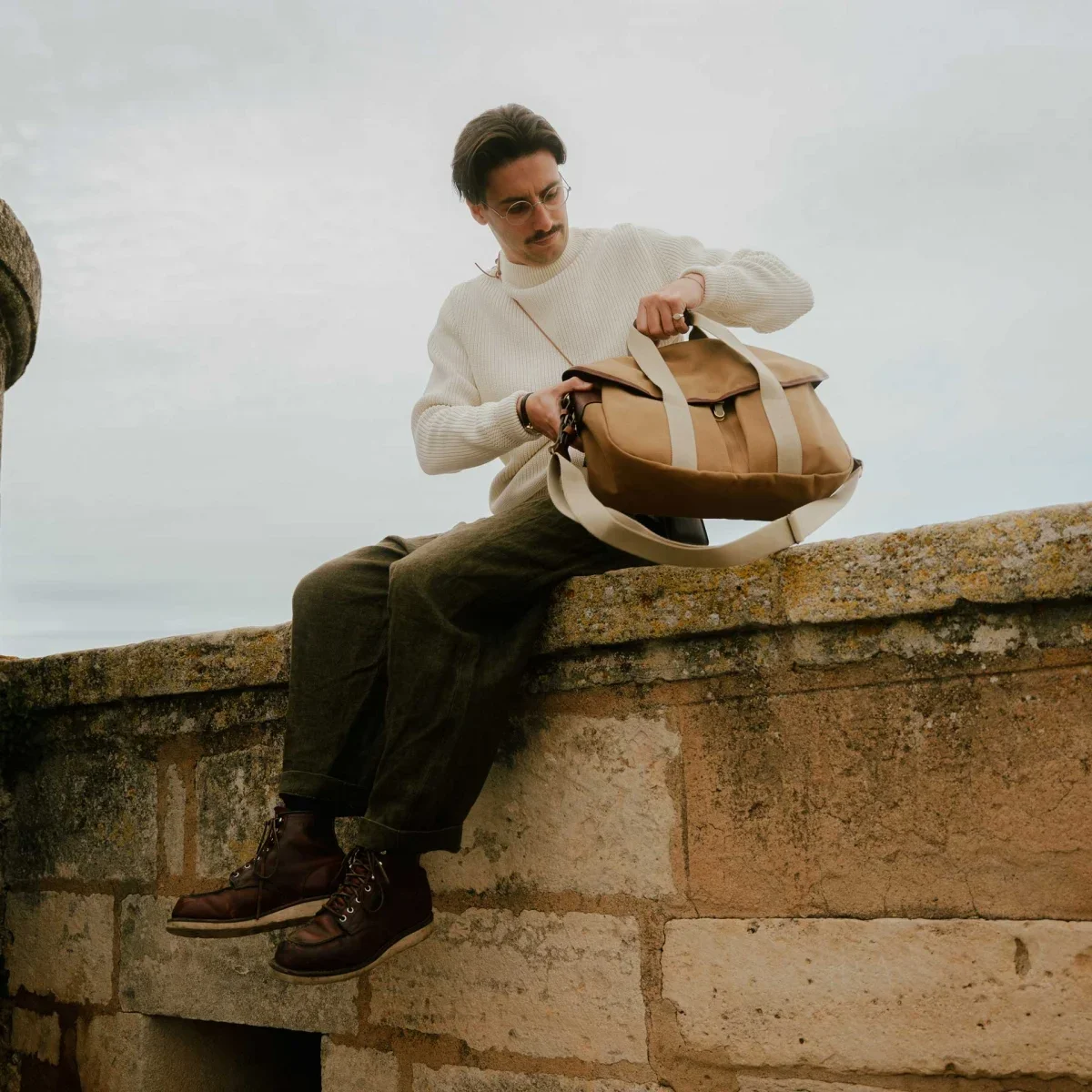
Musette Business BM in Camel
At 395 euros, the Musette Business BM sits in the competitive upper-middle of the carry-bag market, and the combination of French atelier manufacturing, named-artisan signing, Millerain canvas, and direct lineage back to the early twentieth-century musette form is what distinguishes it from its competitors in the same price band.
The Editorial Observation
One closing note, framed explicitly as editorial observation rather than sourced fact. The musette was designed to be carried, every day, for a long time, by someone who needed it. That is the quality the contemporary consumer seems to be reaching for, and it is the quality that a hundred and thirty years of continuous use has baked into the object.
A musette bought today will, with reasonable care, look better in ten years than it does on the day it arrives. That is not a marketing promise. It is simply how the form has always behaved. It is also, quietly, why the bag has outlasted almost every other piece of twentieth-century canvas luggage.
Disclaimer : The Musette Business BM featured in this article was gifted by Bleu de Chauffe as part of an editorial partnership. All opinions and product selections remain the sole responsibility of the AVANT Magazine editorial team.
French workwear, curated in 196 pages of exclusive content:
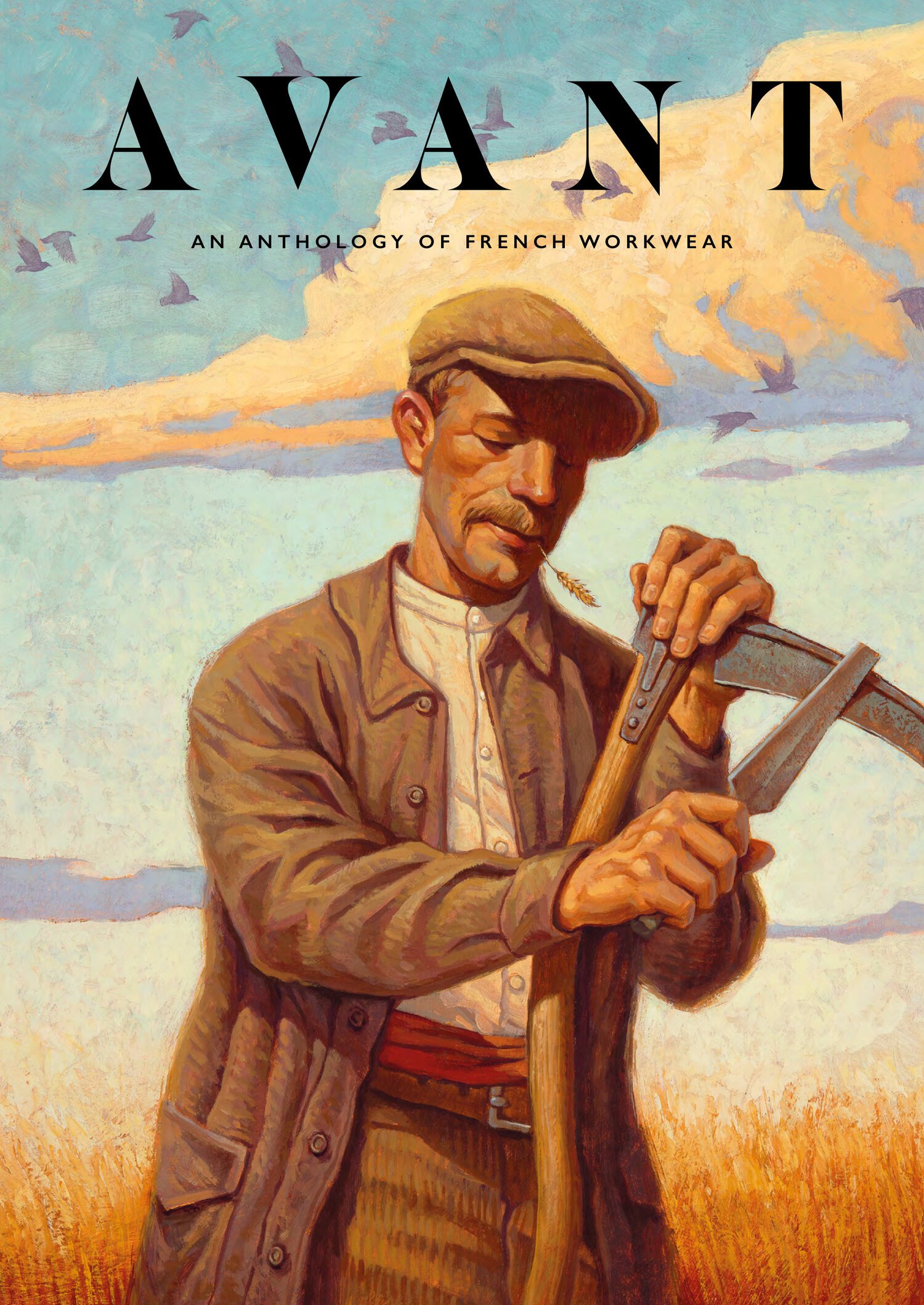
France built some of the most beautiful workwear ever made — worn in mines, fields, and workshops, and now hunted by collectors worldwide.
Inside you’ll discover
The France of the 19th and 20th centuries through workers, farmers, and peasants
Key voices: Tom Gruat, Denis Bruna (Musée des Arts décoratifs, Paris), Frédéric Marc Marion
Why French workwear is booming in Japan (with six Japanese experts)
A visit to Euro-Costumes near Paris — a colossal archive of antique garments
Practical knowledge: moleskin, indigo linen, and how to spot animal buttons on French hunting jackets
Specs
Softcover
170 × 240 mm
Full color
Language: English
Shipping: Worldwide
Sources
Wikipedia. "Haversack," reference entry on the etymology and history of the canvas shoulder bag. https://en.wikipedia.org/wiki/Haversack
Olive-Drab. "World War II Packs: Musette Bag M1936." https://olive-drab.com/od_soldiers_gear_ww2pack_m1936.php
WW2 Facts Wiki. "Musette Bag," reference entry. https://ww2-facts.fandom.com/wiki/Musette_Bag
U.S. Army Quartermaster Foundation. Reference archives on the Musette Bag M1917, M1928, and M1936.
Bleu de Chauffe. "The Fisherman's Musette," brand origin archive. https://www.bleu-de-chauffe.com/en/272-the-fisherman-s-musette
Bleu de Chauffe. Brand history page. https://www.bleu-de-chauffe.com/en/history
Heddels. "Bleu de Chauffe Atelier: An Artisanal Paradise in Aveyron," 2023. https://www.heddels.com/2023/11/bleu-de-chauffe-atelier-an-artisanal-paradise-in-aveyron/
Gents Cafe. "The Courage to Create with Integrity: Bleu de Chauffe and the Art of Making," 2025. https://gentscafe.co/2025/11/28/the-courage-to-create-with-integrity-bleu-de-chauffe-and-the-art-of-making/
Stridewise. "Bleu de Chauffe: How They Make the French Leather Bags American Men Love." https://stridewise.com/bleu-de-chauffe-french-leather-bags/