
Why Americana Is Menswear's Most Romantic Movement
The cowboy and the romantic are supposed to be opposites.
One belongs to the world of utility, hard work, and practicality. The other to emotion, beauty, and imagination.
At least that's the story we've been telling ourselves.
Because if you look closely, the mythology of Americana is built from the same ingredients that fueled the Romantic movement two centuries ago: the solitary figure, the vast landscape, the cult of individuality, the weight of memory, the search for authenticity.
The American wardrobe has spent decades pretending not to care about beauty while obsessing over every trace of it. The fade of a denim jacket. The grain of a leather boot. The hand that stitched a Western shirt. The story hidden inside a garment's wear.
The question isn't why romanticism is suddenly appearing in menswear. The question is why it took us so long to recognize it in Americana.
The Birth of the American Masculine Ideal
For much of its history, American masculinity has defined itself through usefulness.
The national archetypes are familiar: the settler, the pioneer, the rancher, the cowboy. Men who built, repaired, hunted, traveled, and endured. In the American imagination, beauty was rarely presented as a goal in itself. Practicality was. A good jacket kept you warm. A good pair of boots survived the trail. Clothing earned its value through function.
Over time, utility became a virtue and ornament became suspect. The man who cared too much about appearance risked being perceived as frivolous, even inauthentic. The ideal American man wasn't supposed to be elegant. He was supposed to be capable.
And yet, this is where the story becomes interesting.
Because the same culture that celebrated practicality also became obsessed with worn leather, faded denim, hand-tooled details, silver buckles, craftsmanship, and the visible passage of time. It rejected beauty in theory while quietly pursuing it in another form.
What emerged was not the absence of romanticism, but a distinctly American version of it.
Why the Cowboy Was Always Romantic
Picture the great figures of the American imagination: the cowboy crossing an endless landscape, the fisherman alone on a lake before sunrise, the logger disappearing into the forest before dawn.
These men are usually presented as symbols of practicality and self-reliance. Yet they are also deeply romantic figures. They live close to nature. They embrace solitude. They are defined by freedom, individuality, and the pursuit of something just beyond reach. Like all enduring myths, they exist somewhere between reality and imagination.
The same sensibility shaped the objects they left behind. Worn denim. Patinated Red Wing boots. Hand-embroidered Western shirts. Leather jackets creased by decades of use. Americana has always celebrated garments that carry the traces of a life lived. Every scratch, repair, fade, and crease becomes part of the story. Every mark of wear means something. Every fade in the denim is a biography.
Japanese fashion understood this before most Americans did. From the Ura-Harajuku movement of the 1980s and '90s to brands like Iron Heart, Oni, and Japan Blue, designers looked at vintage American workwear and saw something more than utility. They saw objects charged with memory, time, and individual experience. The American jean became not just a garment, but a vessel for personal history.
This is where Americana and contemporary romantic menswear begin to overlap. What designers like Alessandro Michele at Valentino or Palomo Spain express through lace, embroidery, and ornament, Americana expresses through patina, craftsmanship, and wear. One celebrates beauty through decoration. The other through the passage of time.
When Americana Became Self-Aware
If Americana has always contained a romantic impulse, a new generation of designers has stopped treating it as a subtext.
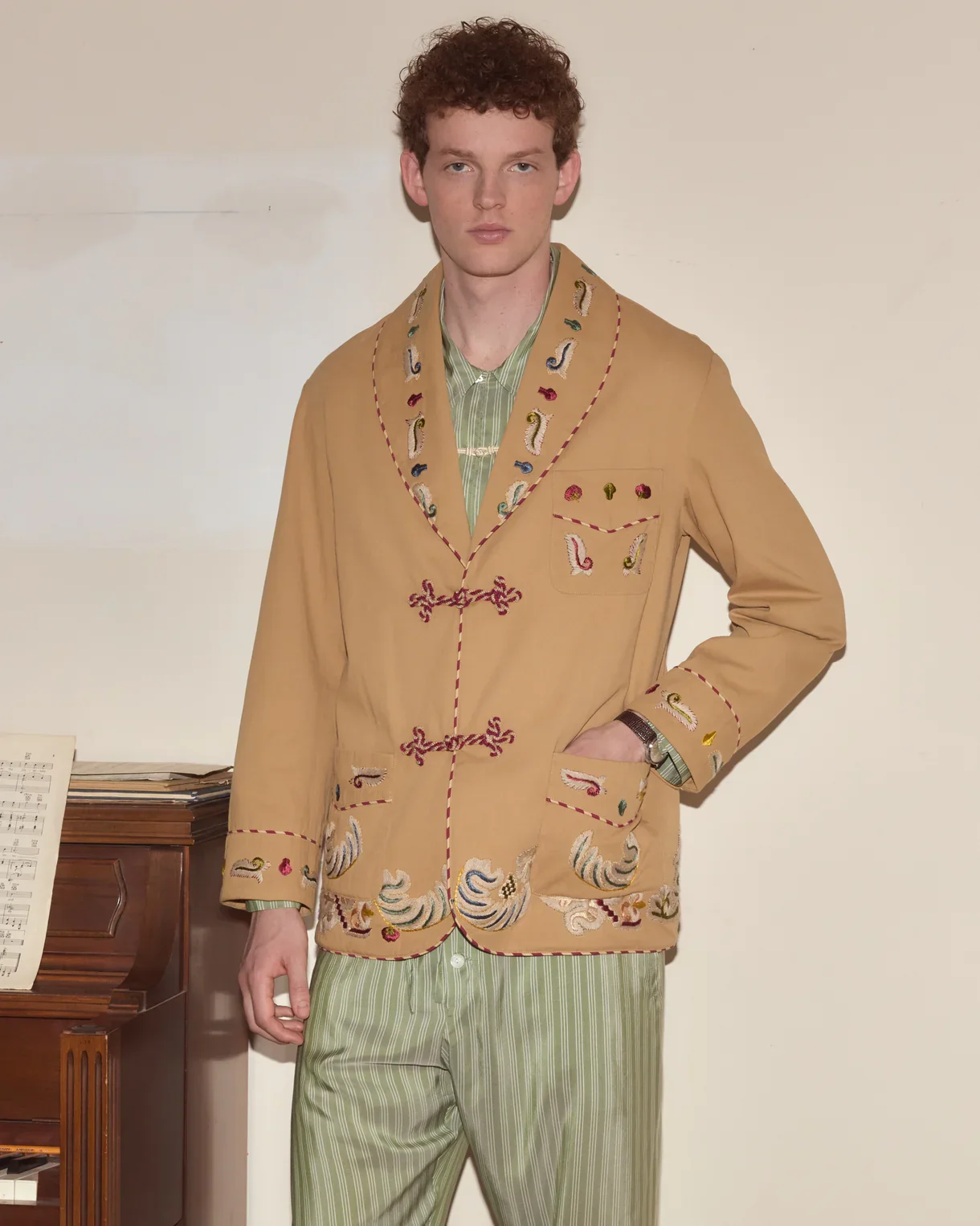
Bode is perhaps the clearest example. Since 2016, Emily Bode Aujla has transformed historical American textiles (quilts, mattress ticking, patchwork blankets, household fabrics) into menswear. A pair of trousers might begin life as a wagon blanket. A shirt might be cut from a decades-old curtain. The result is clothing that makes memory visible. Time, wear, and the human hand are not hidden; they become the point.
Willy Chavarria operates in a different register but arrives at a similar destination. His collections elevate the uniforms of agricultural workers and working-class communities, treating them not merely as functional garments but as carriers of identity, dignity, and emotion. Workwear becomes poetic without losing its roots.
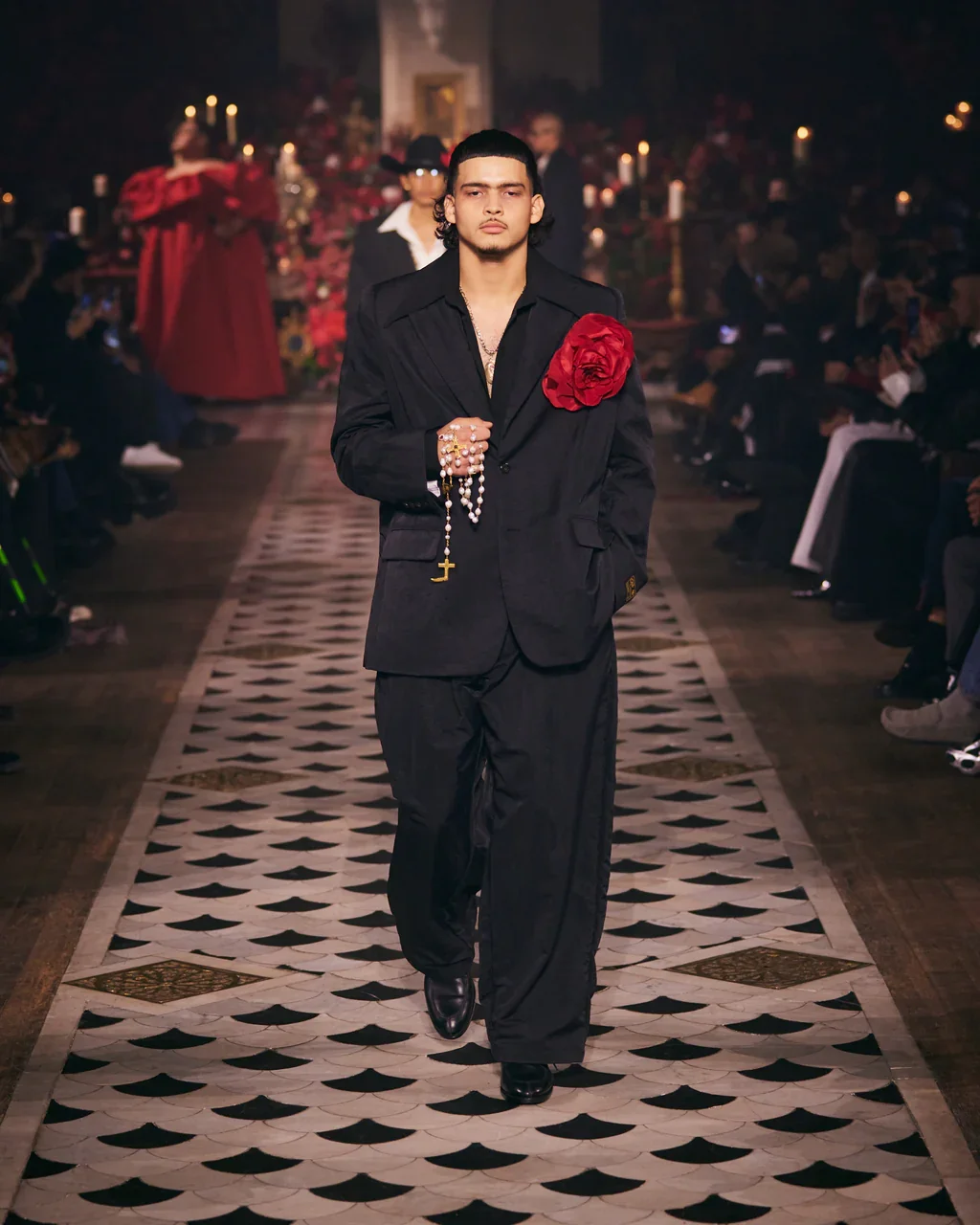
Willy Chavarria fw25
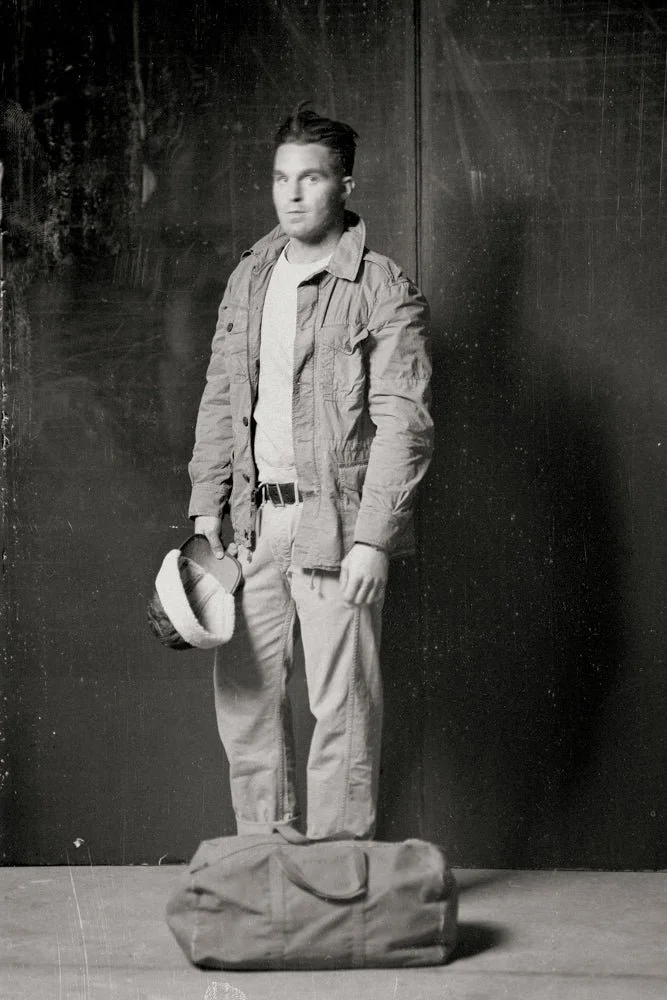
RRL has been practicing this form of American romanticism for decades without ever naming it. Faded military jackets, bleeding indigo denim, weathered leather, garments meticulously aged to look lived-in—its entire aesthetic rests on the belief that objects become more beautiful through time. What appears to be an obsession with authenticity is often an obsession with memory.
Even brands like Corridor have begun to blur the boundaries. Floral embroidery appears alongside denim and madras. Delicate details coexist with traditional American workwear references. The result feels less like a departure from Americana than an expansion of it.

What these brands share is a refusal to treat utility and beauty as opposites. They recognize that Americana has always contained both.
Ralph Lauren's Romantic Moment
If there was one collection that crystallized this shift, it was Ralph Lauren's Spring/Summer 2027 show in Milan.
The setting was pure Ralph Lauren fantasy: a mahogany speedboat recalling the golden age of Lake Como, paired with morning coats, velvet bows, flowing neckties, and impeccably tailored linen trousers. It was elegant, nostalgic, and unmistakably romantic.
Yet the most interesting detail was also the easiest to miss.
Among the collection were evening pumps covered in silk necktie fabric.
Not loafers. Not boots. Pumps.
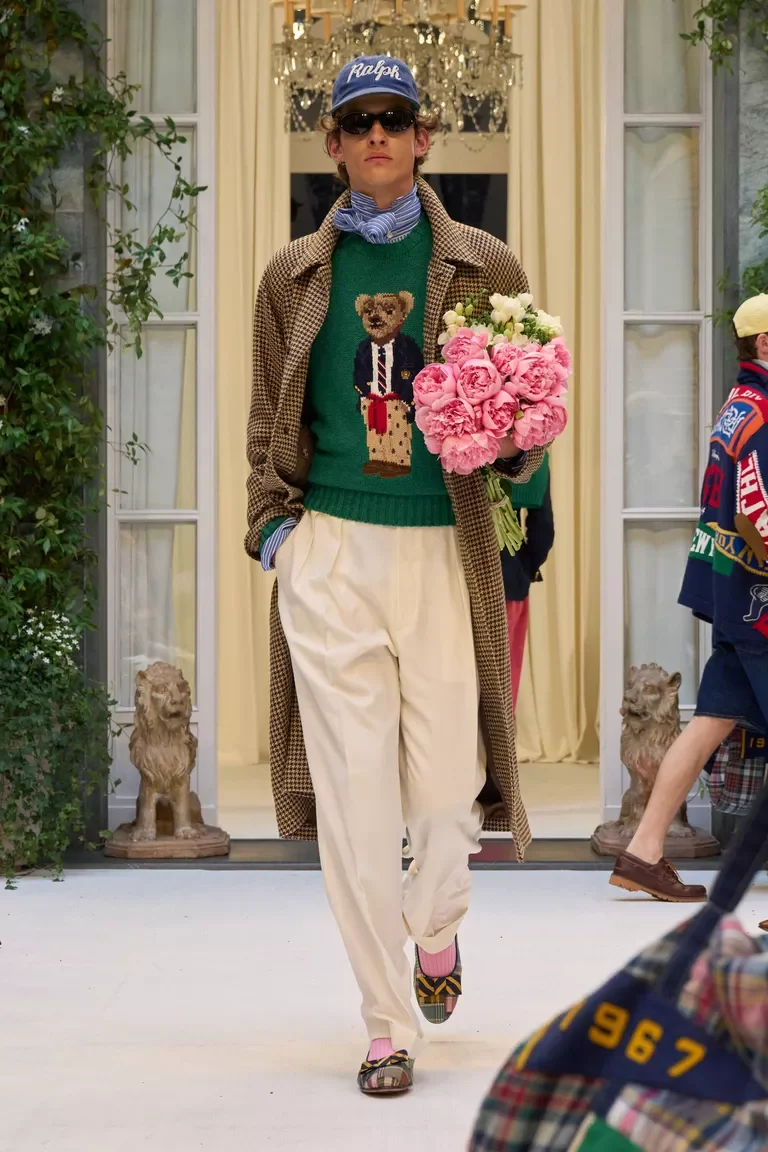
Ralph Lauren's Spring/Summer 2027 in Milan.
At first glance, they seemed almost out of place within Ralph Lauren's universe. But the more one considers them, the more they feel inevitable.
Because Ralph Lauren has always been less interested in utility than in storytelling. His world is populated by ranchers, sailors, explorers, Ivy League aristocrats, English gentlemen, and Western drifters. These characters may wear different clothes, but they share the same purpose: they transform dressing into a form of mythology.
The silk pump simply made visible something that had long existed beneath the surface.
For decades, Ralph Lauren has celebrated faded denim, weathered leather, hand-crafted details, and garments that appear shaped by time itself. The emotional charge of those objects has always been central to the brand. Milan merely extended that logic into a more overtly elegant register.
What made the collection interesting was not that it challenged masculinity. It didn't.
It suggested that masculinity had always contained more complexity than it was willing to admit.
The Wyoming rancher, the Newport gentleman, and the Lake Como aristocrat no longer appeared as separate characters. They became different expressions of the same man. A man comfortable with utility and beauty, ruggedness and refinement, authenticity and fantasy.
In that sense, the collection felt less like a departure than a revelation.
For years, fashion has spoken about romanticism as something arriving in menswear from the outside. Ralph Lauren's Milan show suggested the opposite. The romance was already there. We simply chose to notice it.
The Modern American Romantic
The most convincing evidence for this shift isn't found on a runway. It's found in culture.
For years, menswear treated ruggedness and romanticism as opposites. One belonged to the cowboy, the worker, the outdoorsman. The other to the artist, the dandy, the dreamer.
That distinction is becoming harder to maintain.
Consider Post Malone. Throughout the past few years, he has built a personal style around cowboy hats, Western boots, embroidered velvet shirts, turquoise jewelry, and heavily personalized clothing. The remarkable thing is not that he wears these pieces. It's that no one questions his masculinity because of them. If anything, they reinforce it. Country music—a cultural world often associated with traditional ideas of manhood—has embraced him wholeheartedly.
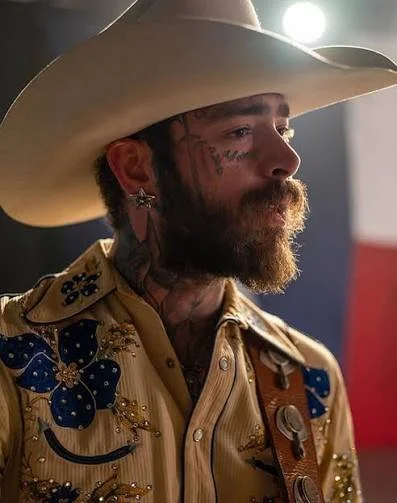
Lil Nas X pushed the experiment further. His wardrobe combines the visual language of the American West with a level of theatricality traditionally reserved for pop stars and rock icons. Fringe, rhinestones, embroidery, color. The cowboy becomes performer without ceasing to be a cowboy.
Tyler, the Creator arrives at a similar destination from another direction. Through vintage Americana, prep, expressive color, and deeply personal styling choices, he has spent years demonstrating that individuality and masculinity are not competing values.
What these figures share is not a rejection of Americana but an expansion of it.
They understand something that fashion is only beginning to articulate: the American wardrobe was never as emotionally neutral as it claimed to be. The romance was always there—in the stories, the craftsmanship, the symbolism, and the desire for self-expression.
The difference is that today's generation no longer feels the need to hide it.
Rethinking Americana
One of the enduring myths of American style is that it belongs exclusively to the world of utility.
The cowboy, the rancher, the outdoorsman, the worker—these figures are often presented as practical men wearing practical clothes. Yet a closer look reveals something more complicated. Western shirts were embroidered. Boots were engraved. Leather was tooled, dyed, and decorated. Even the most functional garments carried traces of craftsmanship, individuality, and ornament.
Americana never rejected beauty. It simply expressed it differently.
This is perhaps why the current conversation around romanticism in menswear feels less like a revolution than a recognition. The language may have changed, but the impulse remains familiar. What some designers express through lace, silk, or embroidery, others have long expressed through patina, craftsmanship, and the visible passage of time.
The engraved Western boot and the opera pump. The faded denim jacket and the embroidered shirt. They belong to different traditions, but they are animated by the same desire: to make clothing mean something beyond its function.
Seen through that lens, Americana is not the opposite of romanticism. It may be one of its purest forms.