The Chimayo Jacket: America's most storied garment
There are garments, and then there are objects of devotion. The Chimayo jacket is the latter : a piece of wearable American history so quietly radical in its construction that once you understand what it carries, no other jacket will feel quite the same.
Born in the high desert of northern New Mexico, handwoven by families whose names have not changed in eight generations, and rediscovered by every generation of men who have ever needed to feel grounded in something real, the Chimayo jacket is not trending. It has simply always been right.
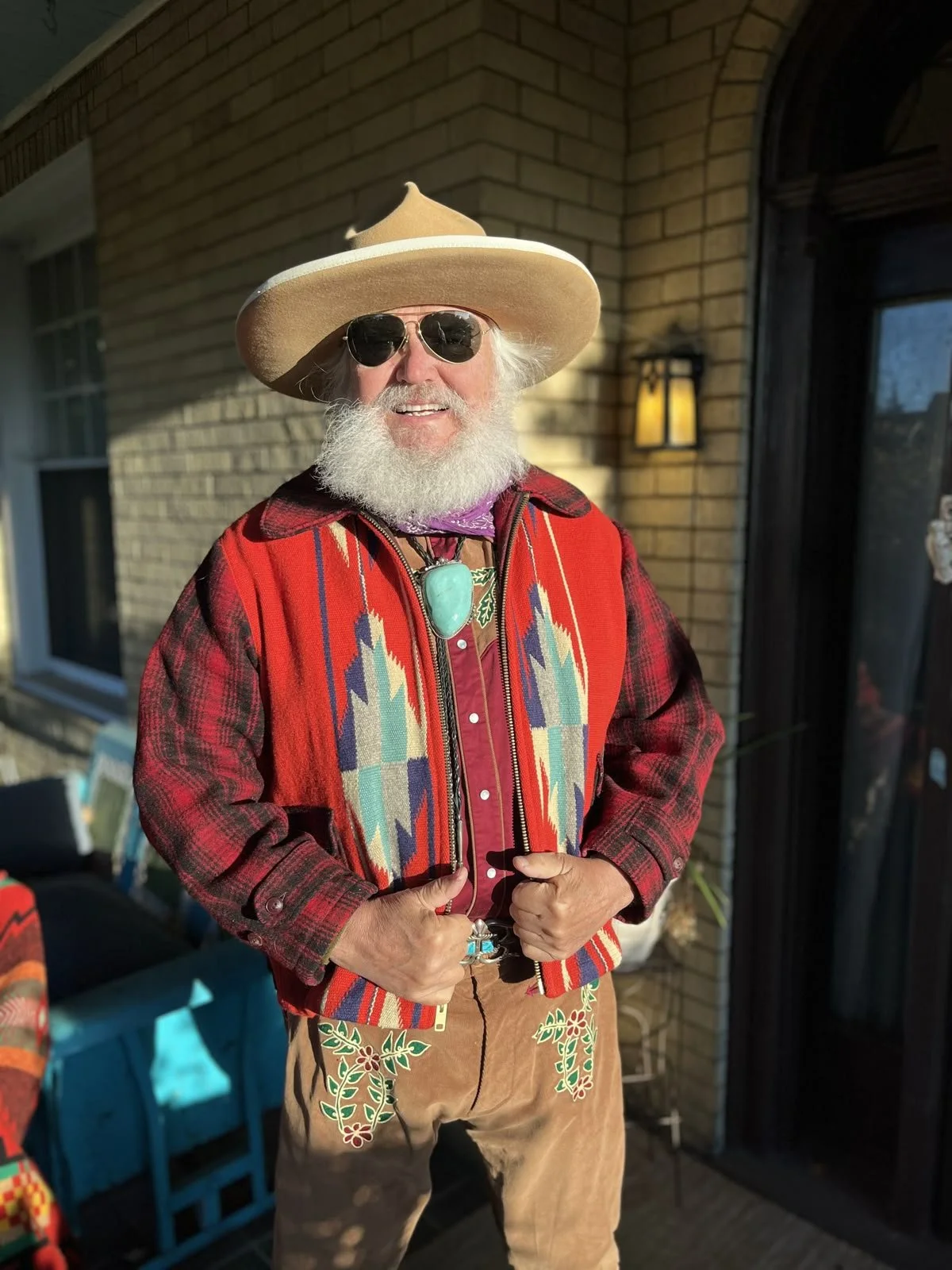
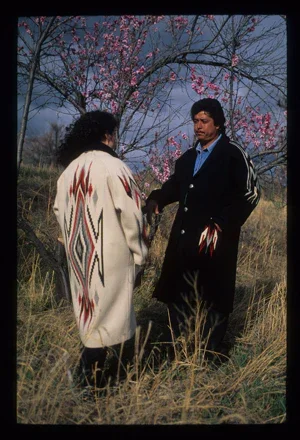
Philip Rupp known as Cowboy Phil wearing a Chimayo style jacket
A Village, a Loom, and Four Hundred Years
To understand the Chimayo jacket, you must first understand the village it came from. Chimayó sits in the Sangre de Cristo Mountains of northern New Mexico, roughly 30 miles north of Santa Fe, a place so remote and so insistently itself that the outside world has never quite managed to absorb it. Spanish colonists arrived in the early 1600s, and with them came churro sheep, whose wool was dense, resilient, and perfectly suited to the high-desert wind. Francisco Vázquez de Coronado's 1540 expedition had brought nearly 5,000 of these animals into the Southwest; by the time settlers took root in Chimayó, weaving had become as essential as breath.
The loom became the backbone of survival. Men and women wove blankets, rugs, clothing ( let’s say everything) from raw churro wool dyed with local plants: wild indigo, chamisa, the iron-rich earth itself. Out of this necessity emerged one of North America's most distinctive textile traditions: the Rio Grande style, characterized by vertical striped patterns interrupted by bold central medallions, serrated diamonds, and Vallero stars. The technique is called weft-faced weaving, where horizontal threads completely cover the vertical warp, creating a fabric of extraordinary density and warmth. It is a cloth that does not age. It is a cloth that outlives its owner. And you know how much we, as heritage and crafts storytellers, love it.
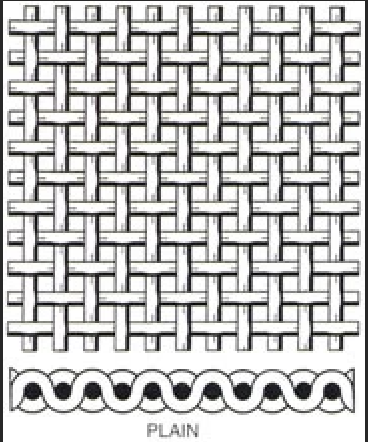
Plain Weaving in theory
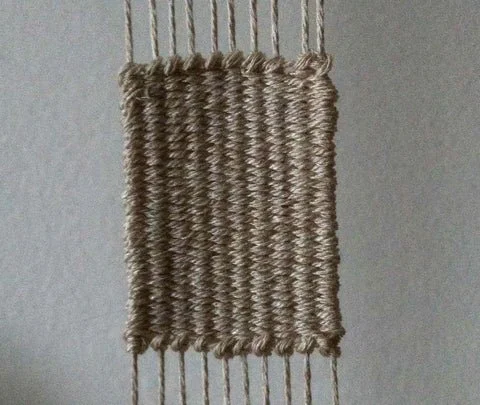
Plain Weaving in practice
Among the families who defined this tradition, two names rise above the rest: the Ortegas and the Trujillos. Gabriel Ortega arrived in Chimayó in the early 1700s and passed his skill down through eight generations. By the turn of the 20th century, Ortega descendants had begun formalizing the craft into commerce, opening the weaving shops along the village's central plaza that would define the region's identity for the decades to come. (Whether it was Reyes or Nicasio Ortega who first opened a dedicated shop, around 1900 or 1918, historians still quietly debate; what is beyond dispute is that the Ortega name became synonymous with Chimayo cloth.) The Trujillos trace their lineage back to Diego Trujillo, who settled in Chimayó in the mid-1600s.
Today, Centinela Traditional Arts, run by the Trujillo family, continues to weave on antique floor looms, using techniques that have changed almost nothing in four centuries.
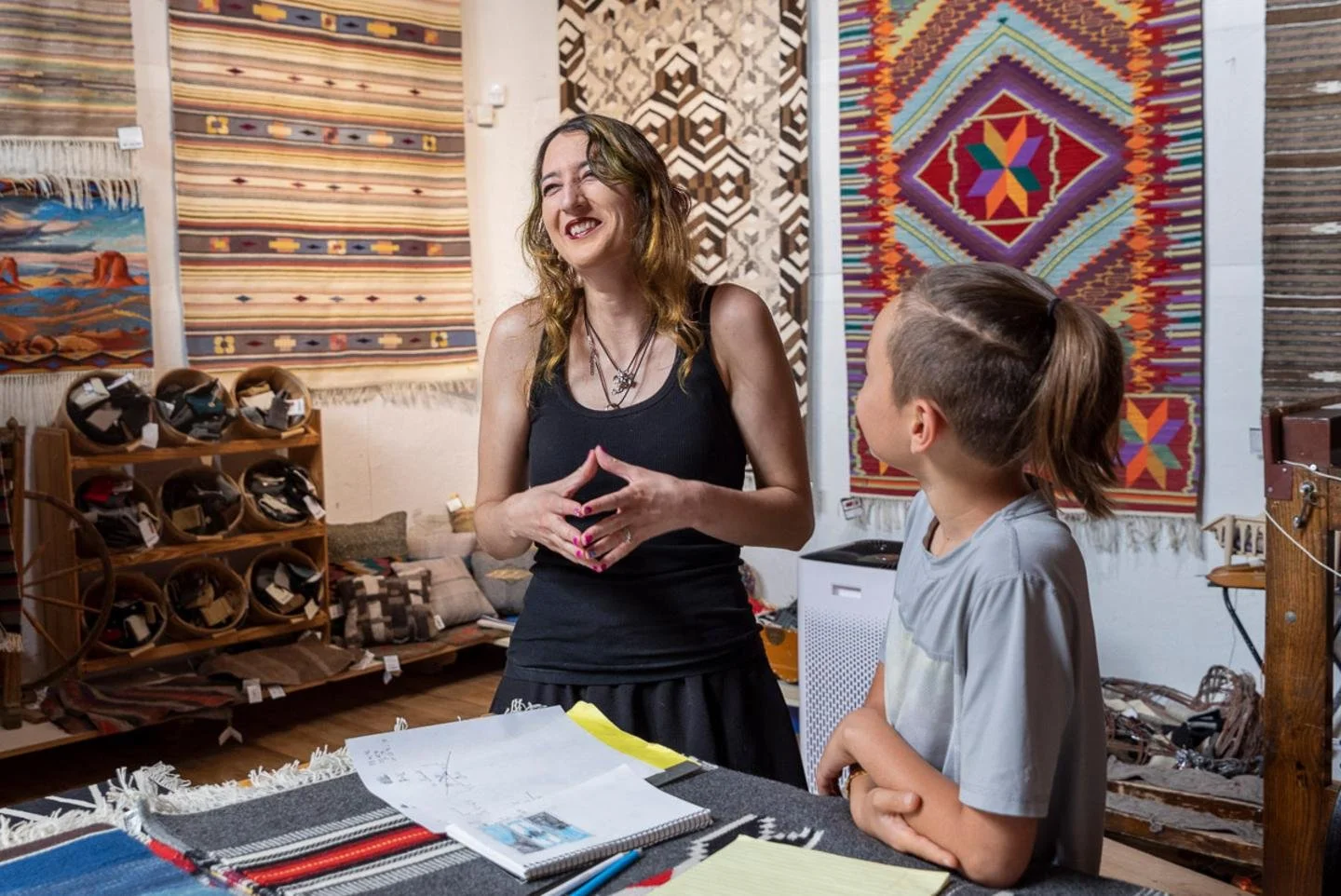
Emily Trujillo at at Centinela Traditional Arts, New Mexico.
The Jacket Itself: An Act of Wearable Translation
The Chimayo jacket was not an inevitable outcome of the weaving tradition. It was an act of creative adaptation and it happened at a precise moment in American history.
By the 1920s and 1930s, the Santa Fe Railway was making the American Southwest newly accessible to Eastern men hungry for something they couldn't find in department stores. Writers, painters, prospectors, and self-invented wanderers rode west in search of a different kind of American identity. Chimayó's weavers responded with intelligence. The large blankets and serapes that had served their families for generations were beautiful but impractical to carry home. So the weavers pivoted: pillow covers, purses, vests and, most significantly, jackets. Ollie McKenzie is credited with designing one of the first true Chimayo jackets around 1930, understanding that the blanket's architecture could be translated into a structured, wearable silhouette without losing its soul.
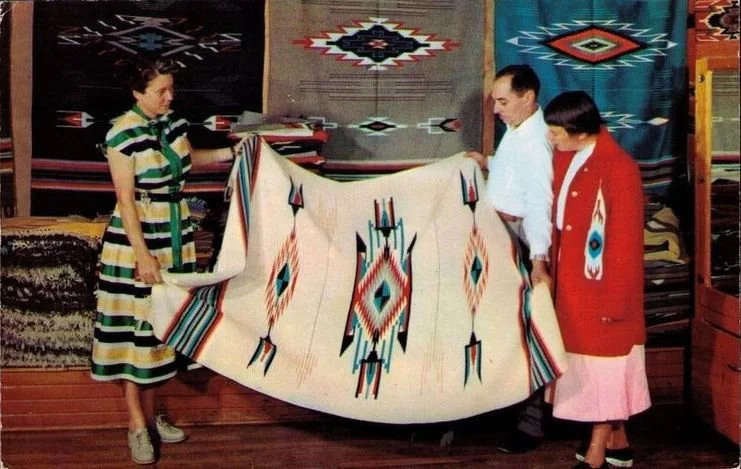
The result was architecturally precise: the handwoven Chimayo panel becomes the body of the jacket, its geometric patterns centered and symmetrical as if placed by hand, because they were. The sleeves are traditionally cut in corduroy, often 11-wale cord, providing a textural counterpoint to the woven wool. Silver concho-style buttons fasten the front. The fit is boxy by necessity and by instinct because the textile dictates the form.
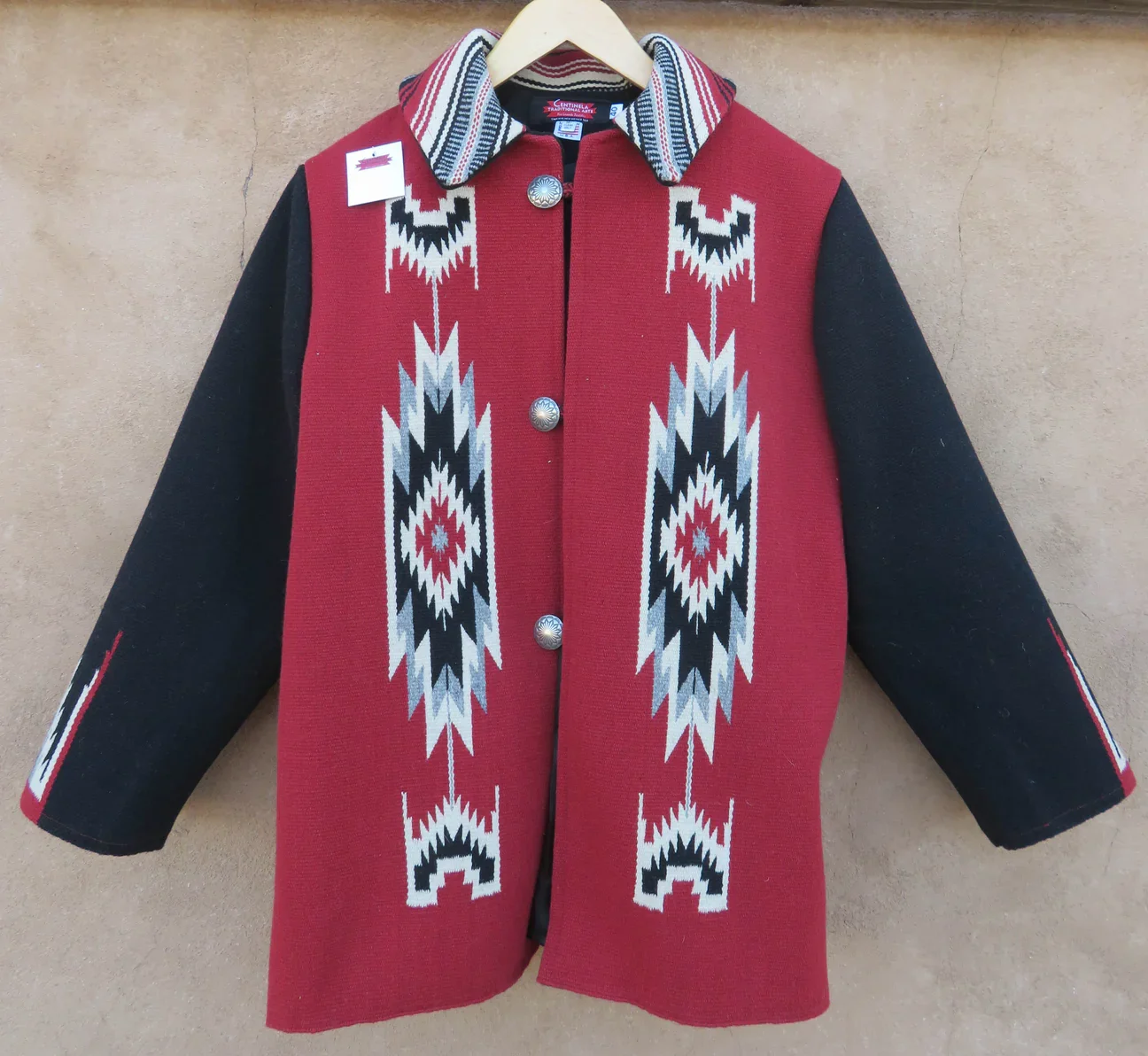
Concho Style Chimayo Jacket from Centinela Traditional Arts
The 1930s and 1940s were the Chimayo jacket's first golden age. Photographs from this era show them worn by travelers, painters, and Hollywood leading men drawn to the Southwest's mystique, the kind of man who understood that real style came from real places.
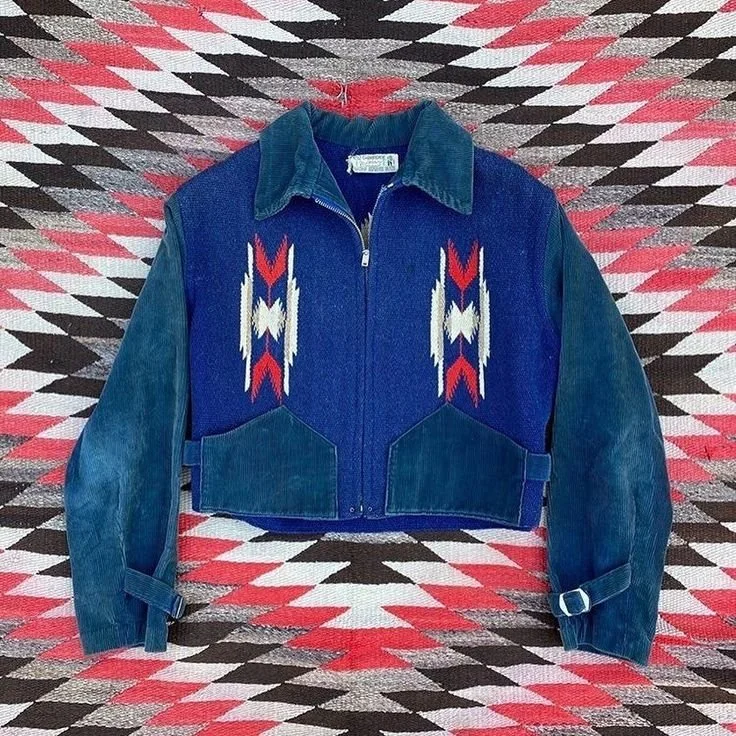
On the Antiques Roadshow circuit, 1940s Chimayo jackets consistently fetch collector-level attention, valued not just for their rarity but for their condition : these pieces, made from raw churro wool woven so tightly they resist water and time, remain wearable decades later.
The Craft That Cannot Be Rushed
What makes a Chimayo jacket irreplaceable is not nostalgia : it is physics.
The weft-faced weave structure creates a fabric with a weight and drape that no machine-made textile can replicate. The handlooms used in Chimayó, many of them genuinely antique and some dating back centuries, produce a cloth with natural variation, slight irregularities in tension that give the surface its life. These are not defects. They are the signature of a human hand making a decision at 140 picks per inch. You can feel them when you run your fingers across a panel. A man who has worn one knows immediately that the comparison with any synthetic alternative is absurd.
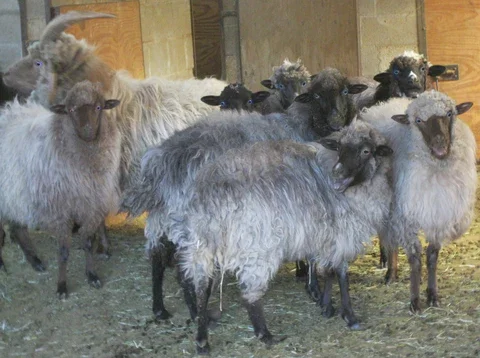
The wool itself matters enormously. Authentic Chimayo weaving uses raw churro wool or increasingly, wool sourced from domestic mills with centuries of their own history. Willie Taylor & Co., one of the contemporary producers continuing the Chimayo jacket tradition, sources raw wool from a 150-year-old American wool mill; their corduroy sleeves come from a mill in Brescia, Italy, operating since 1883. Every component has a biography.
The dyeing process, whether traditional vegetable-based or modern, produces the palette Chimayo is known for: terracotta reds, deep turquoise, charcoal, ivory… colors that read as desert light at dusk, and that somehow hold their own against a New York winter or a Paris side street. The patterns themselves follow established vocabularies: the central diamond medallion, the chevroned stripe, the Vallero star. But within these conventions, each weaver's hand leaves its own inflection. No two Chimayo jackets are identical. This is not a selling point. It is a fact of how they are made.
From Santa Fe to Seventh Avenue
Fashion has never been able to stay away from the Chimayo jacket for long.
In the 1980s, Ralph Lauren, the American designer most committed to the mythology of heritage dressing and the idea that the well-traveled man was the most compelling man, incorporated the Chimayo aesthetic into his Ralph Lauren Country collection, producing southwestern blanket jackets that brought the Rio Grande palette to Seventh Avenue. Lauren understood something important: the jacket's power came not from imitation but from proximity to an authentic textile tradition. A man wearing one of those pieces wasn't dressing up as a cowboy. He was signaling fluency in the deeper register of American style. Those pieces now command serious prices on the vintage market, traded alongside original Chimayo jackets from Ortega's and Centinela as companion artifacts of the same American story.
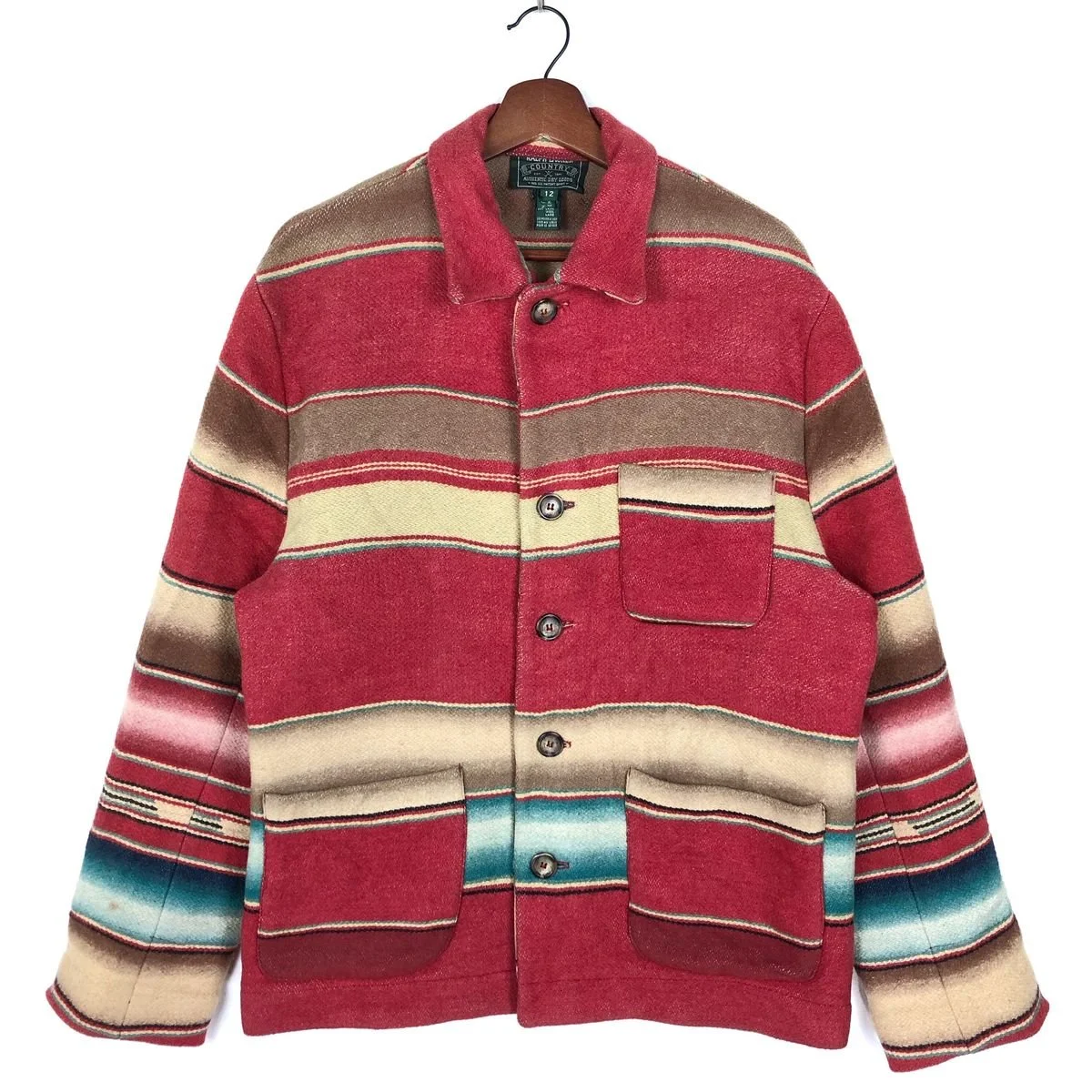
1980s Ralph Lauren Country Chimayo Style Jacket
Ariat, more recently, has brought the Chimayo aesthetic into a contemporary men's workwear register, collaborating with southwestern textile traditions to produce jacket styles that bridge ranch culture and modern dress. The gesture confirms what the vintage market has been saying for years: this jacket does not belong to one era or one tribe.
The resale numbers are telling. On 1stDibs, Etsy and eBay, Chimayo jackets (originals from the 1930s through the 1960s) trade consistently at prices that reflect their dual status as collectible textile and wearable garment. The men buying them are not collectors in the archival sense. They are wearing them. Customers of Centinela Traditional Arts speak of inheriting a Chimayo coat purchased by a father or grandfather during a trip west, worn for decades, still entirely sound despite a lining that gave out long ago. The jacket outlasts everything around it.
The Return of The Real
The cultural moment we are in right now is almost perfectly constructed for the Chimayo jacket's reassertion.
Heritage workwear (the barn jacket, the chore coat, the blanket-lined field jacket) has moved from the margins of men's fashion into its center, carried by a generation of dressers who want clothes with legible histories and tactile credibility. The Chimayo jacket offers both in excess. It is not heritage as aesthetic. It is heritage as material fact: four hundred years of a specific family in a specific village using a specific technique to make a specific thing. That kind of provenance cannot be engineered. It can only be inherited or sought out.
Contemporary makers are meeting this moment with rigor. Centinela Traditional Arts continues to produce handwoven jackets, coats, and vests from their studio in Chimayó, each piece requiring hours of loom time and hand-finishing. Willie Taylor & Co. have built a modern Chimayo jacket that respects the construction traditions while making the garment newly accessible to a man who has never driven through northern New Mexico. On the luxury resale side, the vintage market has never been more active or more internationally minded.
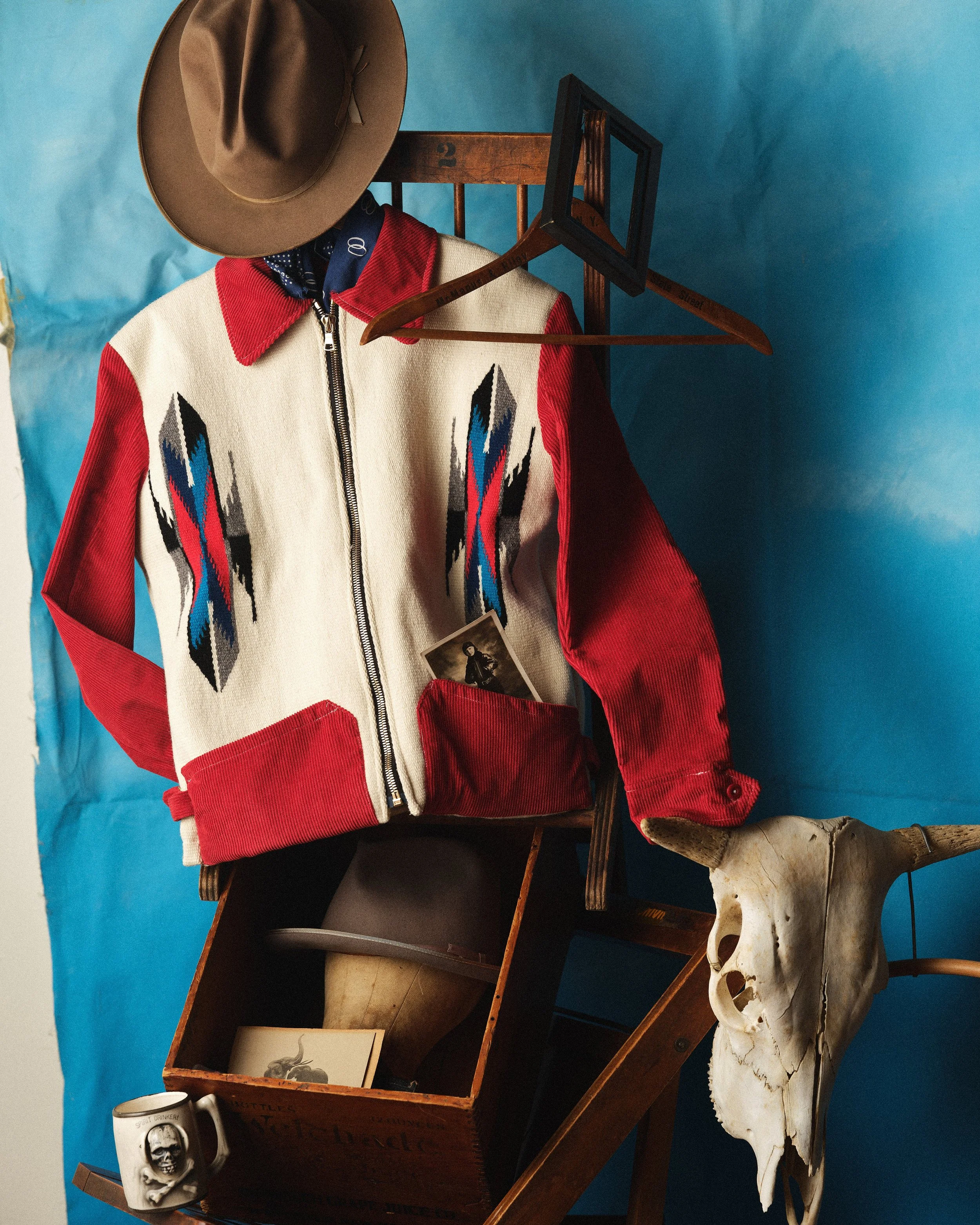
Willie Taylor & Co. Chimayo style jacket
The styling proposition for the contemporary man is clear. Worn open over a thick cream-colored roll neck from Bleu de Chauffe and raw-hem denim, the Chimayo jacket becomes the loudest quiet thing in the room. Closed over a plain white tee with dark chinos and leather boots, it reads as a statement that required no effort because it required all the effort, long before it ever arrived at your door. Layered under a heavyweight overcoat in winter, the woven wool adds insulation without bulk. It is, in the most literal sense, a jacket built for men who spend time outside.
This is the jacket's enduring argument that functional beauty and cultural depth are not competing values but the same value, expressed in wool and time and the particular light of the Sangre de Cristo Mountains. Every generation of men that has been honest with itself has already known this. The Chimayo jacket is simply waiting for you to catch up.
The "Chimayo Style" Jacket: When Industry Discovered a Good Thing
Here is where the story gets complicated and where it starts to matter that you know what you're looking at.
By the 1940s, the Chimayo jacket had caught the attention of the Fred Harvey Company, the hospitality and retail empire built alongside the Santa Fe Railway. Harvey's shops, positioned at railway stops across the Southwest, had been selling southwestern craft goods to tourists since the late 19th century. His operation understood something fundamental about American consumer desire: people wanted authenticity, but they wanted it packaged and ready to carry home. With the Chimayo jacket, he found a product that perfectly fit that need. The Fred Harvey "El Grandee" line, a branded collection of Chimayo blanket coats sold through Harvey railway hotels and curio shops in the 1940s and 1950s, represented a first major commercialization of the form. Crucially, some of these pieces were still handwoven in New Mexico; they occupy an interesting middle ground between genuine craft object and manufactured souvenir. Today they are themselves collected, traded on 1stDibs and Etsy, and debated by enthusiasts.
But the El Grandee line was only the beginning. As the Southwest became shorthand for a certain romantic, frontier-adjacent American masculinity amplified by Hollywood Westerns, Route 66 mythology, and the postwar boom in road travel, the visual vocabulary of Chimayo weaving began to detach itself from its source. The geometric medallion, the chevron stripe, the bold terracotta-and-turquoise palette: these elements were too compelling to stay in one village. Manufacturers across the United States began producing blanket-style jackets that borrowed the aesthetic architecture of Chimayo without the handloom, the churro wool, or the family name behind the shuttle. They called them "southwestern jackets," "blanket jackets," "Indian-style coats." Rarely did they mention Chimayó.
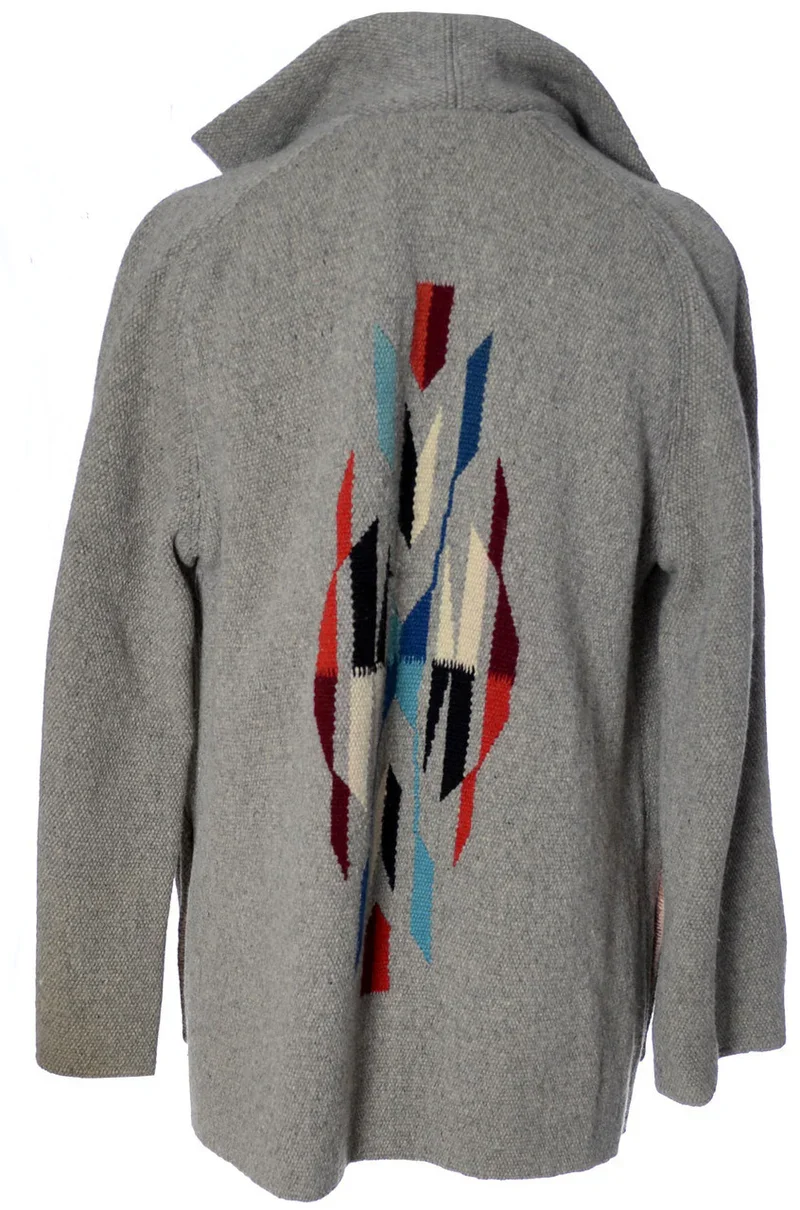

By the 1960s, the "Chimayo-style" jacket had become a category unto itself, an industrial product inspired by a craft tradition, sold at department stores and tourist shops from Albuquerque to New York. The pattern was not new: it was the same transformation that had already happened to Navajo-inspired textiles, to Japanese selvedge weaving once Western denim manufacturers caught on, to the Breton stripe once it left Brittany. A distinctive craft identity becomes a commercial aesthetic, and the original is slowly buried under its own copies.
The damage is specific and ongoing. Today, a man searching for a Chimayo jacket online encounters an overwhelming majority of pieces that have no connection to Chimayó at all: machine-woven southwestern-pattern jackets, fast-fashion blanket coats in approximate colorways, vintage pieces mislabeled as "Chimayo" when they are simply "Chimayo-style." Even on established resale platforms, the distinction is inconsistently made. Knowing the difference requires knowing what to look for : the weight of the cloth, the slight irregularity of a hand-thrown weft, the corduroy sleeve, the silver concho button, and above all, the provenance which is a label from Ortega's, from Centinela, from Ganscraft, from a documented Chimayó weaver.
The Chimayo jacket is not the only heritage garment to have suffered this fate. It is, perhaps, one of the most instructive examples because the original is still being made, in the same village, by the same families, on the same looms. The copy exists alongside the real thing, often at a fraction of the price and a fraction of the meaning. The choice between them is not merely commercial. It is a position on what craft is worth, and who deserves to be sustained by the act of making.
We'll be exploring this question further in our next Garment Stories feature: the heritage pieces that industry industrialized and what gets lost when a craft becomes a category.
Follow AVANT to read it first.
Explore more in our Garment Stories series, the definitive archive of fashion's most significant objects or check our library of Western Wear below.
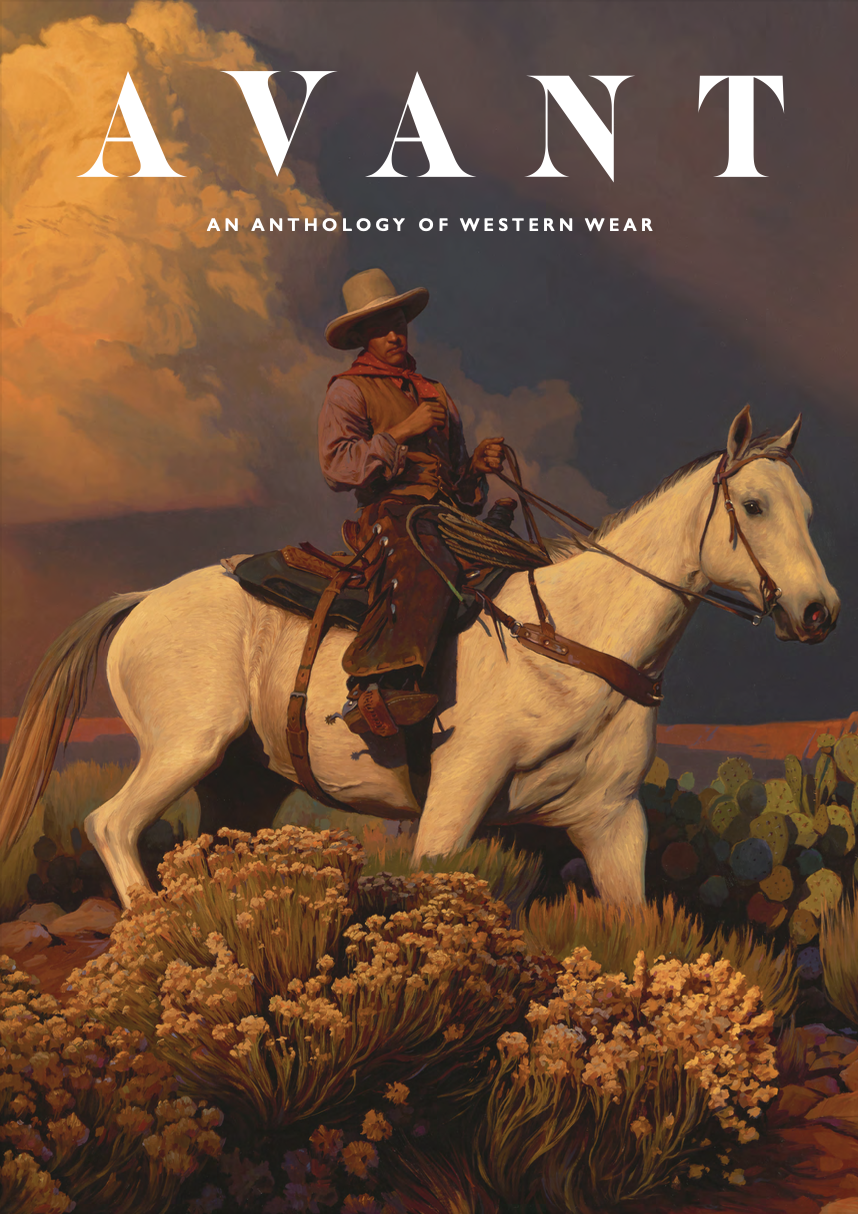
Inside you’ll discover
• The origins of the American cowboy and how the first cattlemen shaped the culture of the West.
• How painters, photographers and Hollywood helped build the myth of the cowboy and turned Western style into a global symbol.
• The evolution of Western clothing through two iconic garments: the Western shirt and the legendary Stetson hat.
• Conversations with passionate figures of the Western world, including Cowboy Phil Rupp, Courtenay De Hoff, Sergio Guardi of Barbanera, and vintage collector Bernie McMahon.
• A deep dive into the heritage of the American West and the lasting influence of Western garments on modern style.
Specs
Softcover
170 × 240 mm
Full color
Language: English
Shipping: Worldwide
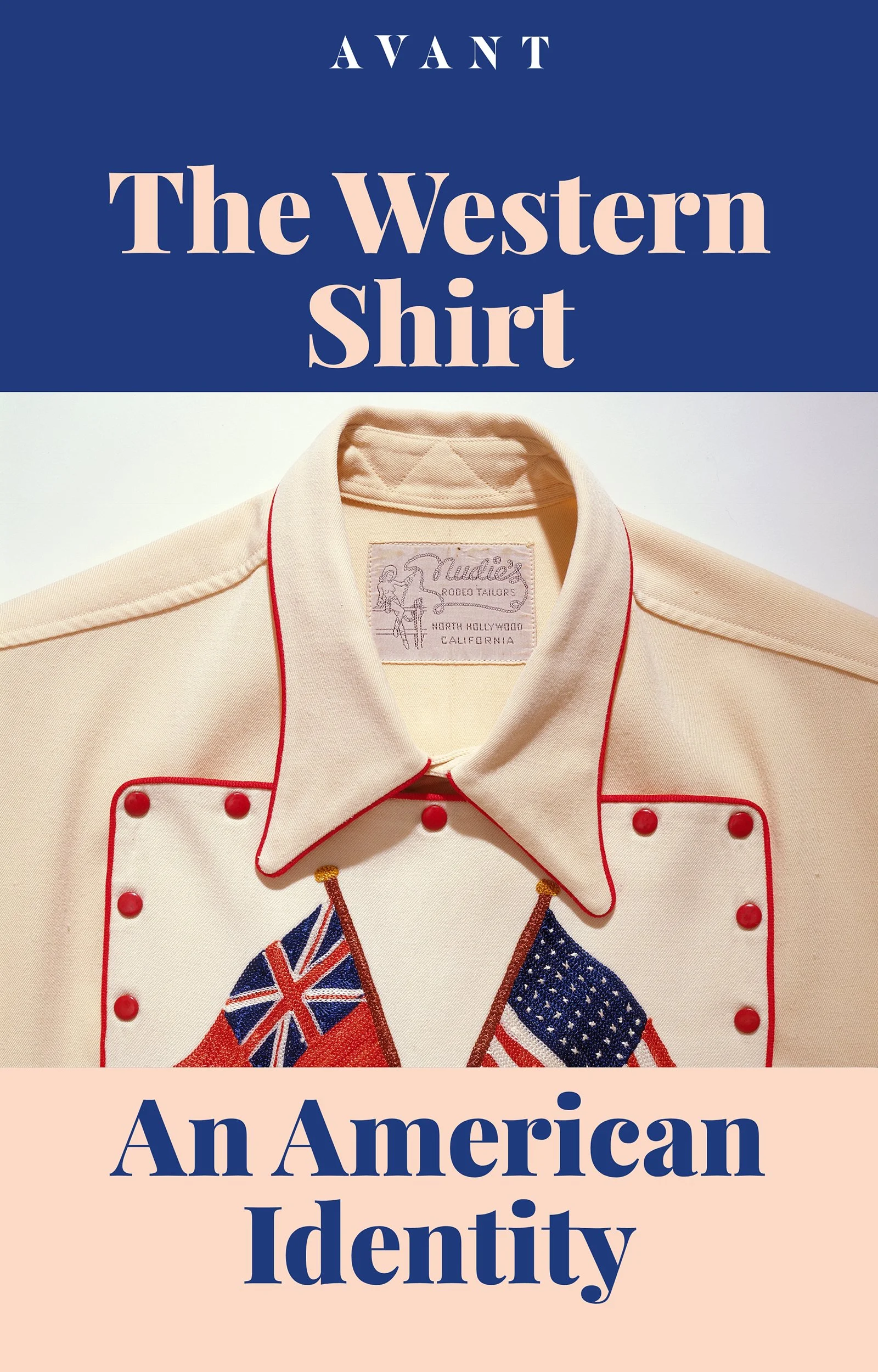
If you enjoyed the Western Wear issue, this e-book is the perfect companion read. Entirely dedicated to the Western shirt, it’s an ideal continuation for anyone still hungry for Americana.
Few clothes have carried as much meaning as the Western shirt. From the first cowboys and rodeo stars to Elvis, Travolta, and today’s designers, it has crossed centuries, styles, and continents.
For this new e-book, we dug deep: the immigrant tailors who made it an art form, the brands that turned it into a staple, the stars who gave it glamour, and the designers who reinvent it today.
From Rockmount to Nudie Cohn, from Yellowstone to Beyoncé, the Western shirt tells the story of America itself. This is not just fashion history. It’s culture, identity, and myth stitched into fabric.
Here’s what you’ll find in the 94 pages of this e-book entirely dedicated to the Western shirt :
The Origins of the Western shirt : First worn by the vaqueros of the 19th century, the Western shirt quickly became a defining symbol of cowboy culture and identity (this article was first published in AVANT#5, An Anthology of Western Wear).
The Historic Designers : A handful of shirtmakers, many of them immigrants from Europe, turned the Western shirt into their craft of choice.
The Classic Brands : The popularization of the Western shirt in mass culture would never have happened without the brands that produced it on a large scale.
The Western Shirt in 2025 : Today, it has become a fashion essential, reinterpreted by both heritage brands and luxury houses.
AVANT Best picks : A selection of 10 Western shirts that capture the dialogue between past and present.
PLEASE NOTE : This is a digital version only, compatible on mobile, tablet and computer.
Please support us by not sharing, not reproducing and not publishing it anywhere. Any reproduction of this electronic book in either electronic means or in printed format is prohibited without written permission of Avant Media. All rights reserved.