Ivy League and the Grammar of Inherited Style

Most fashion vocabularies are learned. Ivy League style has always been sold as inherited instead: something a father hands down along with his old sack suit, something absorbed from a Yale boathouse photograph rather than taught outright. That reputation is part of the appeal, and it is also the part worth arguing with. It has let prep style, ivy style, and what the algorithm now calls the old money aesthetic feel like a closed room, when the whole wardrobe actually runs on a documented, learnable grammar: a specific shoulder, a specific collar roll, a shell cordovan loafer that earns its shine through wear rather than polish. A handful of American houses, and one very determined British one, wrote that grammar down piece by piece over the past two centuries, and it can be read as plainly as any other history. That is the case for learning it properly. Once the rules are visible, dressing in them stops being an accident of birth and becomes, quite simply, a decision anyone can make on purpose.
That case starts with the source text itself. The actual grammar was written by a small number of American houses working from a shared set of rules: natural shoulders, plain fronts, oxford cloth, shell cordovan, a wardrobe built to be handed down rather than replaced. Four names carry most of that grammar today: Brooks Brothers, J. Press, Alden, and, by a more circuitous but well documented route, the British house of Barbour. Reading them in order is close to reading the language's own etymology.
The Campus as the First Classroom
Ivy League style did not begin as a look. It began as a uniform for a specific institutional life, assembled on the campuses of Harvard, Princeton and Yale between the 1920s and the 1940s, and it was less invented than assembled from parts already lying around: British sporting and country dress, cut down and casualized for American undergraduate life. The signature silhouette, the "sack" suit, dropped the darted, fitted European jacket for a boxier, single-breasted cut with a 3-roll-2 button stance, no waist suppression, and a single hooked vent, worn over lower-rise, unpleated trousers.
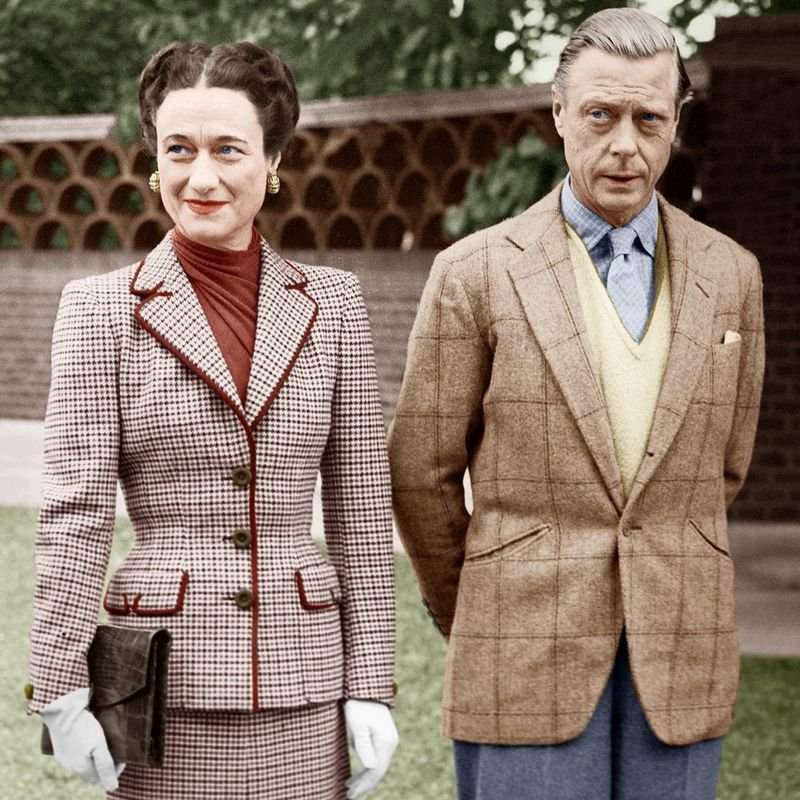
The Duke of Windsor and his wife, Wallis Simpson
The look absorbed foreign material from the start. The Duke of Windsor, watched closely by American style writers through the 1920s and 1930s, habitually mixed American ease with traditional British country dress: brogue boots, argyle socks, tweed sport coats, houndstooth plus fours. That habit of borrowing English country codes and wearing them with American informality is worth remembering, because it is the same habit that would, decades later, let a Scottish waxed-cotton jacket walk straight into the middle of an American wardrobe without anyone treating it as a foreign object.
By the postwar years, the grammar had a second source text: the G.I. Bill sent a wave of veterans to college in khaki military-surplus chinos, and campus style absorbed them as everyday trousers. The style's reach by the mid-1950s was not niche. Historians of the period cite that by 1957 to 1958, roughly seventy percent of all suits sold in the United States were cut in the Ivy League style, a market share that a subculture confined to a handful of New England quadrangles could never have produced on its own. This had become, briefly, the default grammar of American male dress.
Brooks Brothers and the First Verbs of the Language
If Ivy style is a grammar, Brooks Brothers wrote its first verbs. Founded in 1818 by Henry Brooks in New York, the house became, in 1849, the first American clothier to sell ready-to-wear garments at scale, a shift that put a version of upper-class tailoring within reach of a much wider public. The Golden Fleece emblem, adopted in 1850, has marked the brand ever since.
Two garments did the most work. The sack suit, formalized around the turn of the twentieth century, became so associated with the house that it is often described as synonymous with Brooks Brothers itself. And the oxford cloth button-down shirt, the OCBD, has an origin story that has become part of the house's own mythology: John E. Brooks, a member of the founding family, is said to have noticed English polo players buttoning their collars down to keep them from flapping during play, and brought the detail back to New York as a shirt collar. Whatever the precise mechanics of that moment, the button-down collar became, and remains, the single most recognizable garment in the entire Ivy vocabulary.
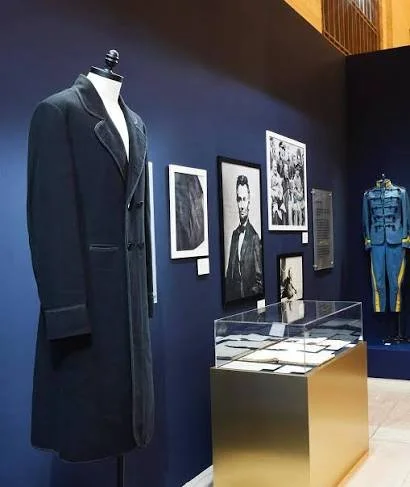
Brooks Brother’s coat belonging to Abraham Lincoln
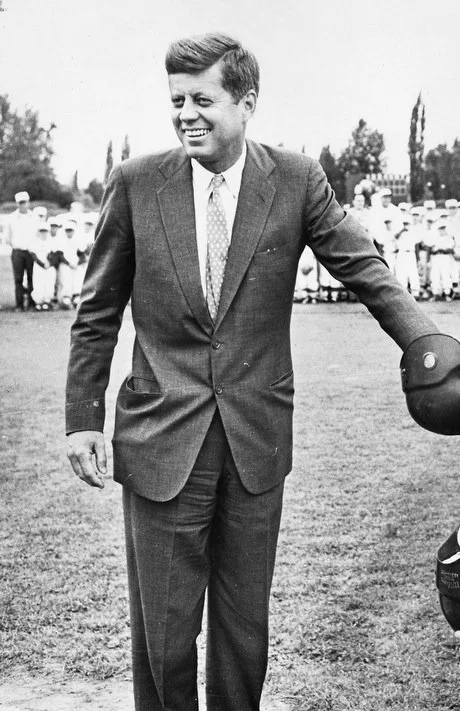
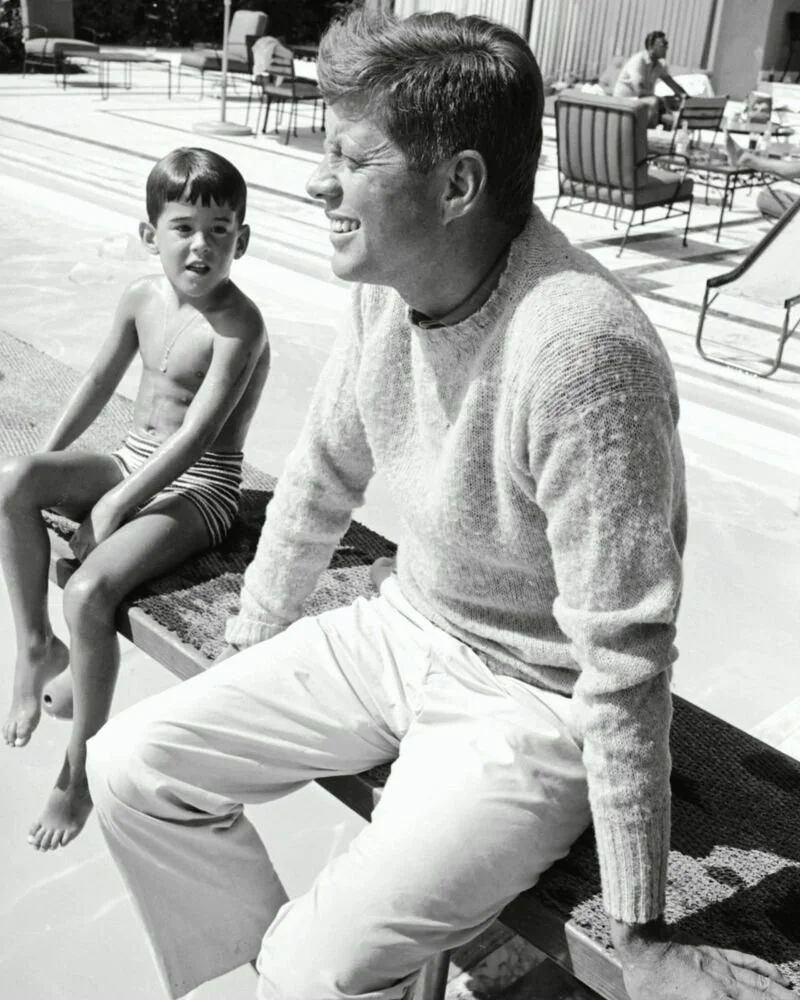
John F. Kennedy wearing Brook Brothers
The clientele reinforced the grammar's authority. Abraham Lincoln was assassinated wearing a Brooks Brothers coat. Forty of the forty-five presidents of the United States have been dressed, at some point, by the house, and John F. Kennedy was known to favor its two-button suit over the traditional three. When a garment has been worn by that many people in power without needing to announce itself, it stops being a style choice and becomes something closer to punctuation: understood, assumed, rarely commented on.
J. Press and the Yale Dialect
If Brooks Brothers supplied the grammar's verbs, J. Press wrote its most severe dialect, spoken without much interest in being liked by people outside the room. The house was founded in 1902 directly on Yale's campus in New Haven, Connecticut, by Jacobi Press, a Latvian immigrant who had originally crossed the Atlantic intending to become a rabbi and instead learned custom tailoring from an uncle. The Press family ran the business for over seventy years, and it was Jacobi's son, Irving E. Press, who is credited with the house's most beloved sweater, the "Shaggy Dog" Shetland, alongside its Indian madras jackets and its sack jackets cut in muted, traditionalist cloths.
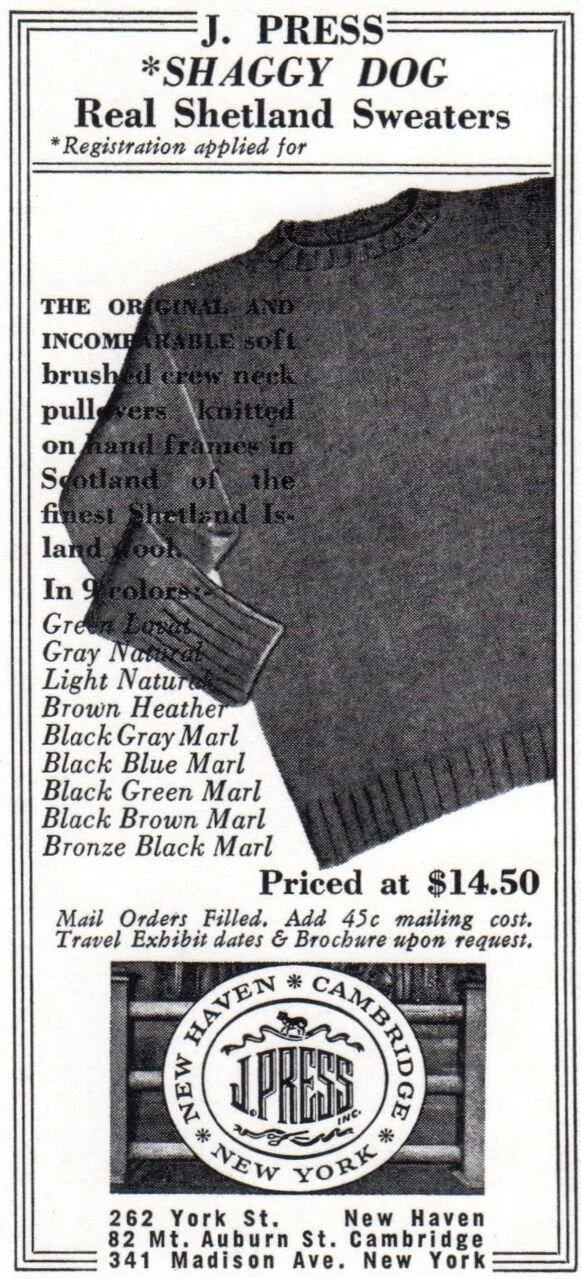
The house's cultural footprint outran its store count almost from the start. Duke Ellington, Cary Grant and Robert Frost were customers in the 1920s, and F. Scott Fitzgerald, writing to his daughter in 1936, warned her, in a line the brand itself now recounts as part of its history, to beware the wolves in J. Pressed tweed: proof that by the mid-1930s, the clothes had already become shorthand for a certain kind of confident, tailored menace. In 1974 the Press family licensed the brand to Japan, making J. Press the first American clothier ever licensed there, and in 1986 the Japanese firm Onward Kashiyama, its longtime licensee, acquired the company outright. It remains part of the Onward Group today, with designer Jack Carlson named creative director in 2025, and its flagship still trades a few streets from the Yale campus where it began.

Jack Carlson, J.Press Creative Director since 2025
Alden, G.H. Bass, and the Sentence Below the Knee
Every grammar needs its punctuation, and in Ivy style, punctuation happens at the ankle. Alden Shoe Company was founded in 1884 in Middleborough, Massachusetts, and remains, notably, still owned by the founding family, with second and third-generation shoemakers still on its factory floor. Its reputation rests on Goodyear-welt construction and on shell cordovan, the dense, non-porous horsehide typically sourced from tanneries such as Chicago's Horween, which does not crack the way calfskin does and instead develops a slow, rolling shine with wear. Alden's model 405 chukka boot even made its way onto Indiana Jones, a small piece of Hollywood evidence for how far the New England workshop's reach has extended.
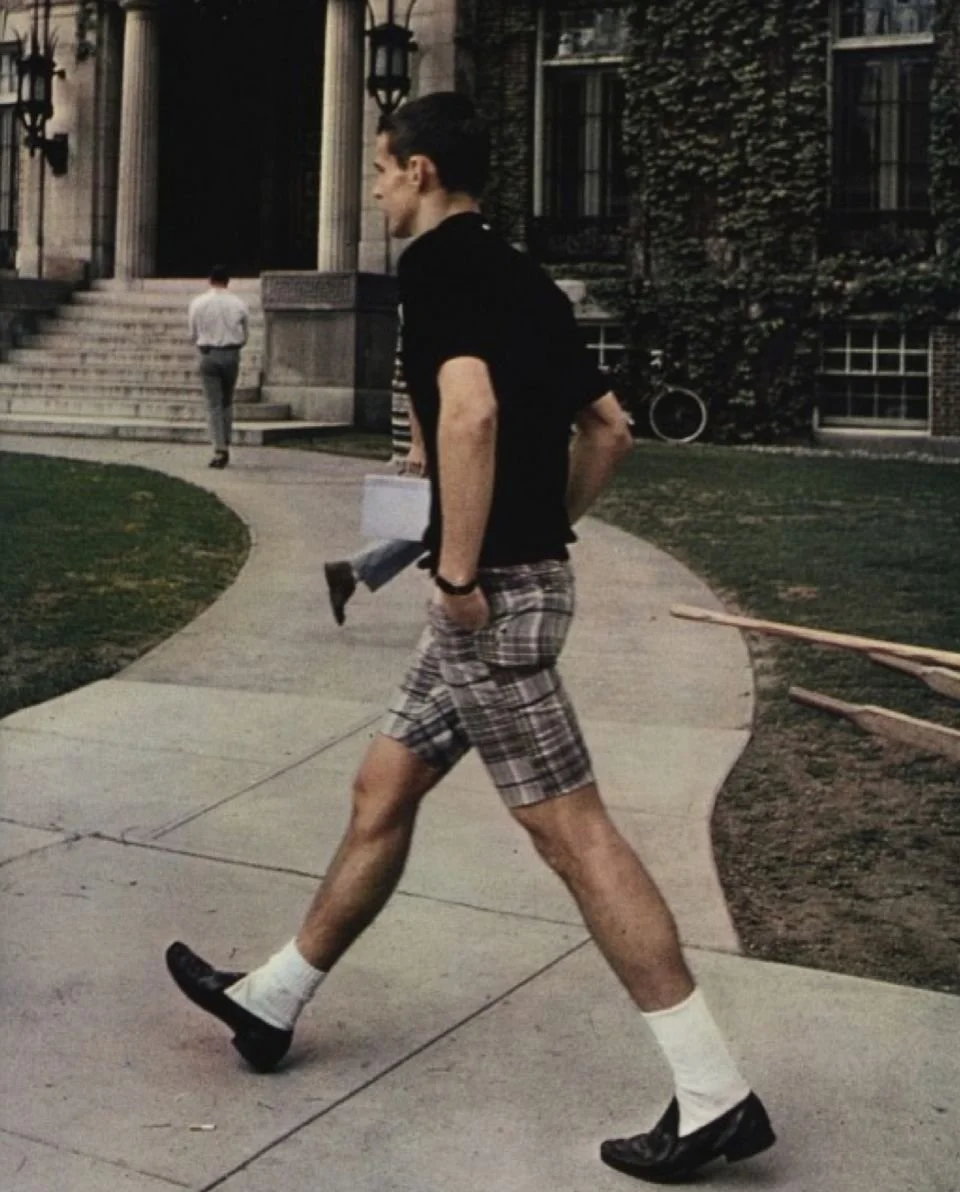
Beside Alden sits the penny loafer, whose own history runs through a different Maine company entirely. G.H. Bass, founded in Wilton, Maine in 1876, introduced its "Weejun" loafer in 1936, a name that nodded to the Norwegian moccasin-making traditions the shoe borrowed from, first advertised in the New York Herald Tribune that May for $6.50. The story that college students slid a penny into the shoe's decorative saddle slot to keep cab or payphone fare on hand is one of the grammar's most repeated legends, and it is worth flagging honestly as legend: Bell System payphones of the era took dimes, not pennies, which makes the tidy version of the story almost certainly apocryphal, even if the name and the habit of tucking a coin there both stuck. By the 1950s, the Weejun had become one of the defining shoes of Ivy League campuses regardless of what, exactly, was in the slot.
Barbour and the Grammar's Borrowed Words
No account of this wardrobe is honest if it treats it as purely American in origin, and Barbour is the clearest evidence of that. The house was founded in 1894 in South Shields, in the northeast of England, by Scottish merchant John Barbour, originally to supply oilskins to sailors and fishermen, and it remains family-run five generations later. Its two most famous jackets came later and for specific outdoor purposes: the Bedale, designed by Margaret Barbour in 1980 for horseback riding, and the Beaufort, introduced in 1983 for shooting and other country pursuits. The house has held a Royal Warrant continuously since 1974, when the Duke of Edinburgh first granted one, followed by warrants from the Queen in 1982, the Prince of Wales in 1987, and King Charles III in 2024.
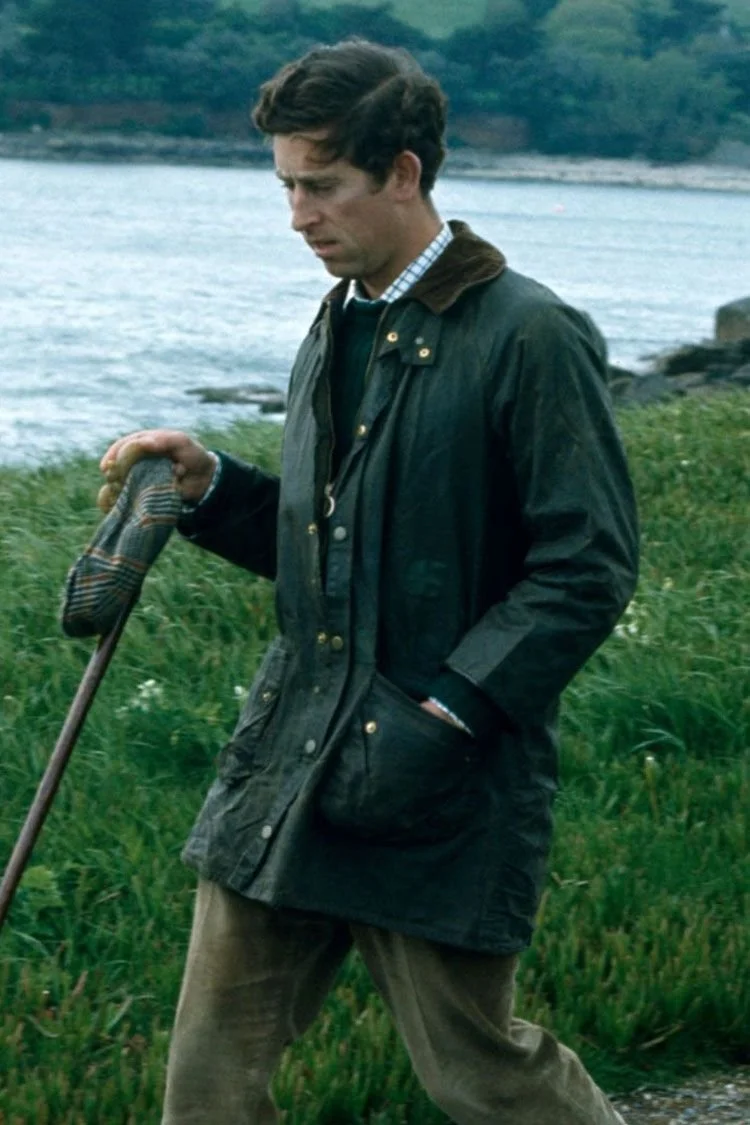
None of that royal country pedigree is American, and no single traceable moment marks the exact point at which Barbour's waxed cotton crossed the Atlantic into the Ivy wardrobe. What can be said honestly is this: the grammar had already been borrowing from English country and sporting dress since the Duke of Windsor's era, and by the time American menswear writers began cataloguing the preppy wardrobe in earnest, Barbour's Beaufort and Bedale were already listed among its staples, described in the trade press as having been, in one recent account, "extremely popular with preps... for years." It is tempting to read that as a direct inheritance running back to the 1930s. The more accurate reading is a shared logic rather than a single lineage: prep style has never drawn a hard line between a New England campus and an English country estate, and Barbour's waxed jacket became the uniform for the weekends spent moving between the two.
When the Grammar Went Global
The clearest proof that this was always a written grammar, capable of being studied and reproduced, arrived from outside the country entirely. In 1965, four Japanese authors, Teruyoshi Hayashida, Shosuke Ishizu, Kurosu Toshiyuki and Hajime Hasegawa, published Take Ivy, a photographic study shot on American Ivy League campuses between 1959 and 1965 and named for a Dave Brubeck composition.
It ran first through the Japanese publisher Fujingahosha and became a foundational text for Japanese menswear, exceeding fifty thousand copies sold worldwide and, decades later, commanding auction prices near two thousand dollars for original Western copies before PowerHouse Books finally issued an English edition in 2010. Designers on both sides of the Pacific, including Ralph Lauren and the founders of J. Crew, have kept it visibly on their shelves ever since, which tells its own story about where the modern reinterpretation of this wardrobe actually studied.

The domestic version of that same democratizing impulse arrived in October 1980, when Workman Publishing released The Official Preppy Handbook, edited by Lisa Birnbach with Jonathan Roberts, Carol McD. Wallace and Mason Wiley. Where the grammar had previously been passed down privately, inside families and inside a handful of Northeastern institutions, the Handbook printed the rules for anyone willing to buy the book, describing L.L. Bean, memorably, as "nothing less than Prep mecca." Its runaway popularity is even credited with inspiring Arthur Cinader to found J.Crew, hoping to meet the demand the book had surfaced. What had been a closed dialect became, almost overnight, an open one.
Want to go deeper into the American wardrobe?
Ivy is only one chapter of the story. The American style vocabulary was also shaped by the clothes of workers, soldiers, cowboys and outdoorsmen: garments that moved from function into culture, and eventually into fashion.
AVANT’s Americana Pack brings three of those histories together: Western Wear, American Militaria, and American Workwear.
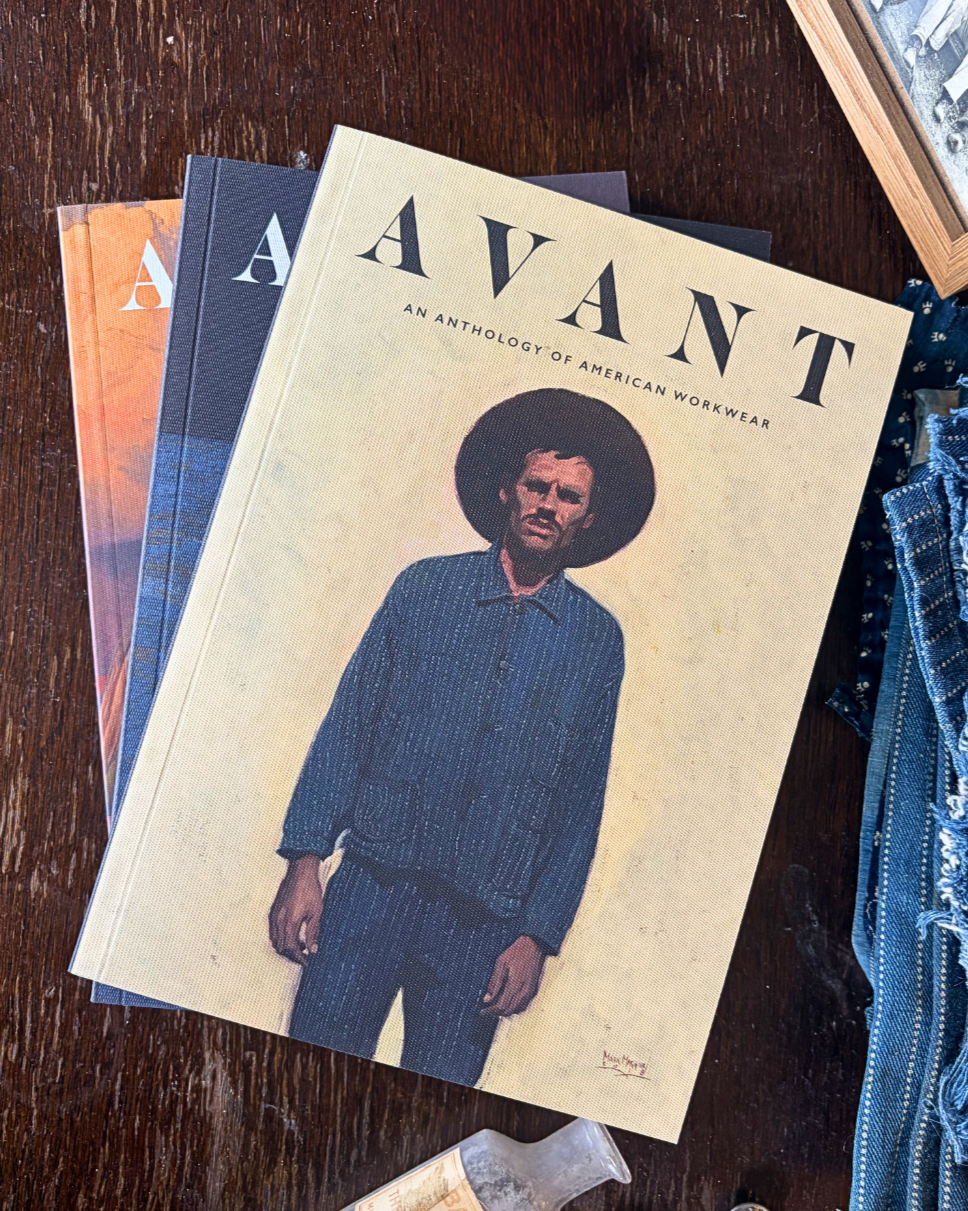
Western. Military. Workwear. The pillars of American style.
A curated trilogy exploring the roots of American heritage through three of AVANT’s most iconic volumes.
$147 → $109
Complete the set and save $38
What’s inside:
1. An Anthology of Western Wear
The mythology of the American West, from cowboys to cinematic icons, exploring the garments that shaped a legend.
2. An Anthology of American Militaria
A deep dive into military garments and their enduring influence on modern style.
3. An Anthology of American Workwear
The origins of rugged clothing built for labor, adopted by culture, and reinterpreted by fashion.
Product details (per book):
Softcover
196 pages
170 × 240 mm
Full color
Language: English
Shipping: Worldwide
Three volumes. 588 pages. A visual and historical library for understanding where modern Americana menswear actually comes from.
The Uniform That Refuses to Retire
That is the actual grammar lesson underneath all of this. Every generation that rediscovers Ivy style believes it has found something new: a hashtag, a TikTok aesthetic, a feed of tennis sweaters and boat shoes filed under "old money." What it has really done is relearn a language that Brooks Brothers began writing in 1818, that J. Press annotated from a storefront a few streets from Yale, that Alden and G.H. Bass finished at the ankle, and that Barbour's waxed cotton extended out into the English countryside on the weekends in between. A grammar survives not because it is enforced but because each generation wants, quite badly, to be fluent in something inherited rather than invented. Ivy League style has understood that difference for over a century. It remains the whole of its appeal, and the reason a button-down collar from 1900 still reads, in 2026, as current rather than costume.
For readers building the wardrobe rather than just the reading list, AVANT's Americana Codes series continues to track this exact lineage, from the romanticism underneath American workwear to the campus garments that carried it into the twentieth century.